Staffy Collar: How to Choose the Right Width, Length and Leather
Short answer:
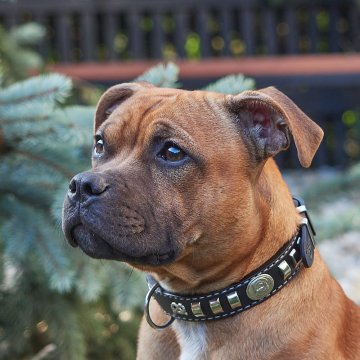
For most Staffies, the best collar is not the narrowest or the flashiest one, but a well-shaped leather collar with enough width to spread pressure, enough structure to stay stable, and the right length so it sits securely without riding loose. If your dog pulls, twists, or throws sudden power into the lead, width and construction matter as much as style.
What collar width, length and leather make sense for a Staffy?
A Staffordshire Bull Terrier is compact, muscular and quick off the mark. That means the collar has to do three jobs at once: sit correctly on the neck, stay predictable under pressure, and survive real life when your dog goes from calm to “absolutely not walking past that squirrel” in one second. A good Staffy collar is wide enough to spread force, properly sized so it does not spin around the neck, and made from leather that keeps its shape instead of turning floppy.
If you are deciding between a decorative option, a stronger everyday classic, or something with a little more control, this is where the topic splits. For a cleaner understanding of how craft and real-life testing shape a durable collar, see how a masterpiece collar is born for your Staffy and when design meets function and collars are tested by real life.
How wide should a Staffy collar be?
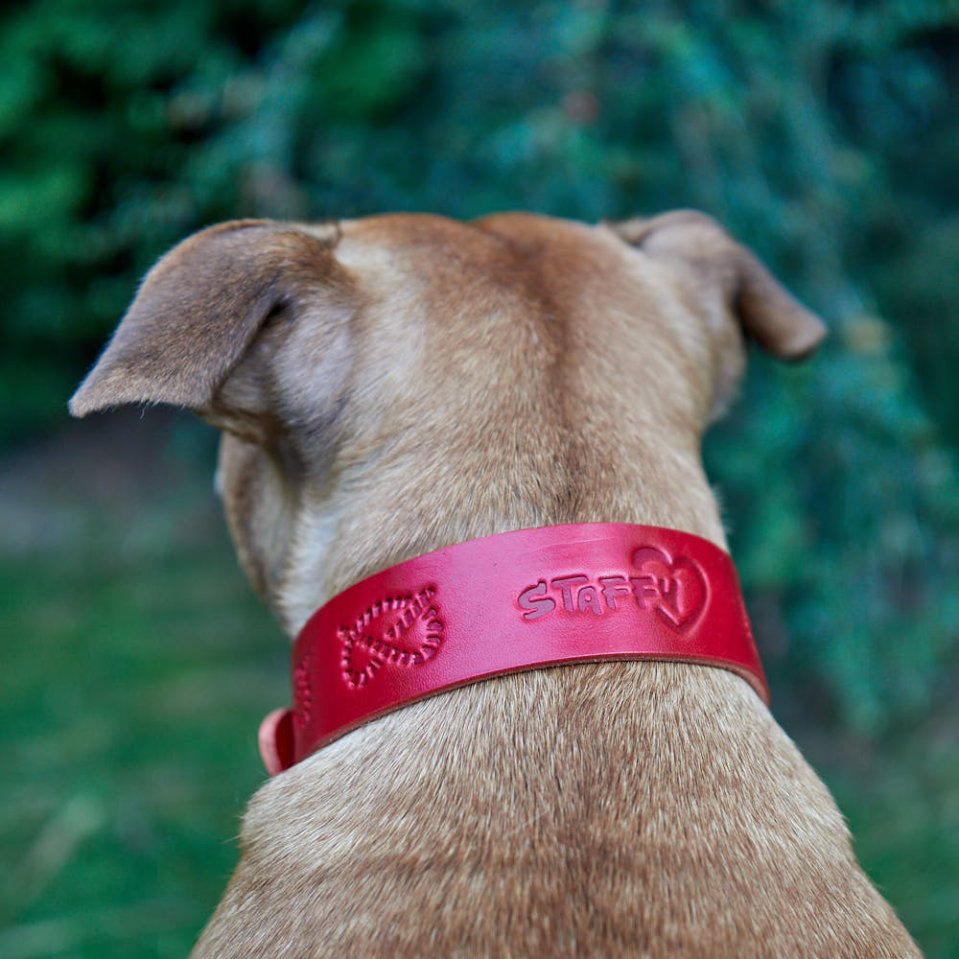
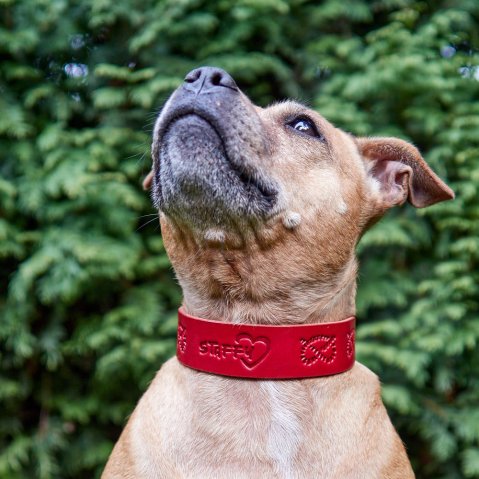
In most cases, a Staffy needs more than a slim strip around the neck. A collar with sensible width spreads pressure better and stays steadier when the dog leans into the lead.
You notice the difference fast. A narrow, soft collar can rotate 90 degrees, push pressure into one line, and start looking “busy” on the neck the moment the dog lunges. A broader leather collar usually sits flatter and behaves more predictably.
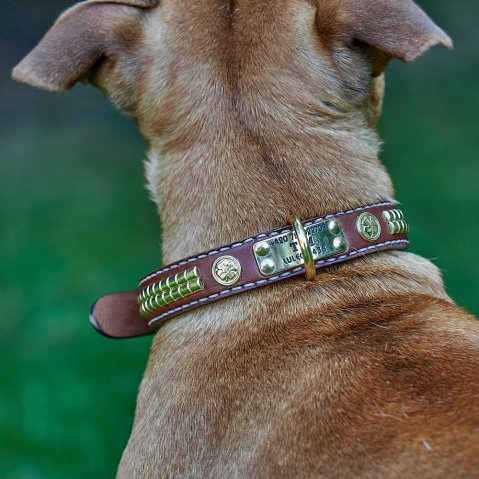
If you want a classic shape with visual presence but still solid everyday use, a Ribbon classic collar makes sense. If you want more sparkle for a Staffy that also appears in the ring or at events, the Prestige classic collar fits better in the show-and-style lane than in the “dog hits the end of the lead like a wrecking ball” lane.
How long should the collar be?
The right length is the one that sits securely without strangling the neck or hanging loose like a bracelet. You want a fit that allows comfort but does not shift all over the place when the dog changes direction.
If the collar is too loose, it starts travelling, twisting and losing stability. If it is too tight, the dog cannot move naturally and the whole thing becomes uncomfortable fast. On a Staffy, poor length is not a small sizing issue. It changes how the collar behaves under load.
What leather works best?
For a Staffy, the best leather is leather that holds shape, keeps strength and ages well. This is not the breed for weak material that looks smooth online and gives up after a few weeks of real walks.
The failure is usually obvious. The holes stretch, the collar softens too much, the hardware starts feeling like the strongest part of a weak build, and the whole piece loses authority on the neck. Pretty on a product photo. Questionable when the dog powers into the lead with its chest and shoulders. That is why leather choice is a function issue, not just a finish issue.
Decision flow: what should you choose?
- If your Staffy walks well and you want an everyday classic: choose a firm classic leather collar with sensible width, such as the Ribbon classic collar.
- If you want ring presence or a more decorative look: go for a refined classic option like the Prestige classic collar.
- If your dog backs out, braces hard, or you need more controlled handling: look at a Crystal Glam Half Check Collar.
- If you are building a matched setup from the start: a Glitter Strap collar and leash set gives you one coherent solution.
- If you are still unsure: solve width and fit first, then style.
Common mistakes
The most common mistake is choosing by appearance alone. A collar can look sharp, slim and elegant in a still photo, yet behave badly once the dog actually moves. The second mistake is underestimating width. The third is treating leather as decoration rather than structure.
Another classic mistake is using a show-oriented style for full-power daily handling without thinking about the dog’s behaviour. Not every beautiful collar is built for every kind of pressure, and that is fine. The trick is matching the collar to the job.
Expert view
From a practical maker’s perspective, Staffy collars live in the gap between control and presentation. That is where weak gear gets exposed. The moment the dog throws one abrupt pull, the truth comes out: does the collar stay stable, or does it twist, bite into one line, and start behaving like an accessory instead of equipment?
If you want to understand why some collars take longer to make and why that matters in real use, read why every collar from our workshop takes so long.
Who this solution suits
- Staffy owners who want better daily control without clumsy handling
- People choosing between classic collar and half check
- Owners who care about how the collar behaves under real tension, not only how it looks
- Handlers wanting a clean, balanced collar line on a muscular neck
- New puppy owners who should also read when to start a puppy with a collar and how to choose the first one
Final summary
For a Staffy, the right collar is usually the one that combines sensible width, correct length and leather with real structure. A collar that is too narrow, too soft or badly sized often tells on itself within five seconds. It twists, drifts and turns control into guesswork. Solve fit first, function second, and decoration third. On a strong little dog, the collar should not just look ready. It should actually be ready.
Frequently asked questions
Is a narrow collar good for a Staffy?
Usually not for daily use. A narrow collar often concentrates pressure and becomes less stable when the dog pulls.
How do I know the collar is too loose?
If it rotates, slides around the neck, or loses position when the dog changes direction, it is likely too loose.
What matters more for a Staffy: leather or width?
Both matter. Good leather without the right width can still behave badly, and good width with weak leather will not hold up long.
When does a half check make sense?
When the dog tends to back out, brace hard, or needs more controlled handling than a standard classic collar gives.
Can a decorative collar still be practical?
Yes, if its structure and fit match the dog’s real use. Decoration alone is never the problem. Decoration without function is.
Featured Dogs