Why Is My Dog Always Under My Feet? 7 Practical Reasons
Short answer:
Your dog follows you everywhere because you are the most useful, familiar and interesting thing in the room. You control food, doors, walks, attention and the daily rhythm. If the dog is relaxed, it is usually normal. If the dog cannot cope when you disappear, that is a different problem and needs calmer training.
Why is my dog always following me?
Your dog follows you because your movement predicts action. Kitchen, leash, door, jacket, shoes, treat pouch, sofa — dogs connect those dots fast. They do not need a calendar. They have eyes, ears, a nose and a frightening talent for noticing the one tiny move that means “something is happening”.
When the dog can stop, lie down and switch off, following is usually just connection. When the dog is stuck to your legs, whining at doors or pacing when you leave, it is time to separate simple attachment from stress. For the next layer of practical dog handling, the Slade Czech guide section gives a useful path forward.
1. You are the safe base
Many dogs follow because being near their person feels secure. Your dog knows your smell, your pace, your voice and the way the house moves around you.
This looks calm: the dog follows, checks where you are, then settles. No panic, no blocking, no drama. Just a dog keeping the pack map updated.
2. Your routine is painfully obvious to your dog
You may think you are unpredictable. Your dog disagrees. The hand to the keys, the shift toward the hallway, the cupboard door, the shoe change — all of it means something.
Try the 5-second test: move toward the treat area and watch the body. Head lifts, ears lock in, paws prepare. That is not magic. That is data collection with a tail.
3. Food has trained the behaviour
If following has ever produced snacks, crumbs or a “fine, have one”, your dog may keep running the experiment. Dogs are excellent accountants when food is involved.
For training, rewards should be ready but not random. The Snack Strap fits this job because it keeps treats available for clear timing instead of buried in pockets where they become dusty little meat coins.
4. Your dog wants interaction
Some dogs follow because they want a response. A look, a word, a hand on the head, even a complaint. If it makes you react, it can become worth repeating.
That is why “stop following me” can accidentally teach “follow harder until the human talks”. Dogs are not being evil. Just efficient.
5. The dog needs more useful work
A dog with too little to do often tracks the human like live television. You stand up, the show starts. You open a drawer, the plot thickens. You go to the bathroom, apparently season finale.
Sniffing, short training, calm leash work and planned rest help reduce this. A dog with a job does not need to invent one under your feet.
6. Alone time feels difficult
If the dog follows because being alone is scary, you will usually see more than simple shadowing. Barking, scratching, drooling, trembling, pacing or full panic when you leave are stronger signs.
This is not a dominance issue. It is a coping issue. The dog has to learn, step by step, that separation is safe and temporary.
7. Some dogs are built for human contact
People-focused dogs, including many bull-type breeds, often want to be where the human action is. They like contact, movement and being part of the household machinery.
That closeness is great when it has brakes. Without brakes, a strong little companion can become a hallway speed bump with opinions.
Decision flow: what should you do?
- If the dog follows and relaxes: keep it simple. Reward calm behaviour and do not overthink it.
- If the dog follows only when food appears: adjust reward timing and stop paying for random shadowing.
- If the dog crowds your legs: teach a mat, bed or place cue before someone trips.
- If the dog panics alone: work on separation gradually and avoid forcing big jumps.
- If control problems appear outside: move into handling, collar fit and leash setup through the dog gear and control guides.
Common mistakes
Paying the behaviour by accident
Food, eye contact, petting and talking can all reward following. If every shadow mission gets a payout, the dog will keep clocking in.
Calling every close dog anxious
A relaxed dog near your feet is not automatically a problem. A dog that cannot breathe, rest or think when alone is different. You can see the gap in seconds.
Letting the dog manage the house traffic
When the dog blocks doorways, rushes ahead or sticks to your knees, the behaviour stops being charming. It becomes a moving obstacle with fur and feelings.
Using treats like loose change
Random rewards create random expectations. A structured setup such as the Snack Strap for cleaner reward timing helps when you want treats to support training instead of turning you into a walking vending machine.
Cute on camera versus useful in real life
A dog following every step can look adorable in a clip. In daily life, it may mean tripping, door rushing, begging, nervous watching or a dog that never truly switches off. A sweet shadow is fine. A stressed shadow needs a plan.
Practical view from Slade Czech
Most behaviour grows from repeated little moments. Dog follows. Human responds. Dog learns. Repeat for weeks and suddenly the owner says the dog is “always there”. Usually, the dog did not become strange overnight. The routine trained itself.
At Slade Czech, we think in real handling terms: pressure, movement, pulling, control, reward timing and the moment life tests the setup. Whether it is a collar, leash or treat accessory, pretty is not enough. Gear and habits have to work when the dog gets ideas.
That is exactly where our story comes from — hands-on work, leather, dogs and everyday use before polished slogans.
Who should read this?
- Owners whose dog follows calmly but constantly.
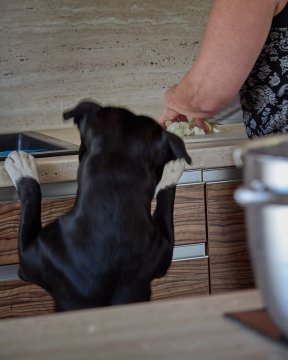
- People whose dog begs in the kitchen or stands under their feet.
- Owners of strong, people-focused breeds that need clear household rules.
- Families where dogs and children share space; the next useful read is living together with a child and a dog.
- Handlers who use rewards and want cleaner timing without pocket chaos.
Final summary
Your dog follows you because you matter. You may mean safety, food, routine, movement or comfort. The important part is whether the dog can relax when nothing happens. Calm following is usually fine. Panicked following needs patient work.
Keep rewards clear, teach calm distance and give the dog a routine that makes sense. The best shadow is one that can switch off when the show is over.
Frequently asked questions
Why does my dog follow me into every room?
Because your movement predicts something. The dog may expect attention, food, a walk or simply wants to stay close to the person they trust.
Should I ignore my dog when they follow me?
You do not have to ignore all following. Reward calm behaviour, avoid paying pushy shadowing and teach the dog where to settle.
Why does my dog panic when I close a door?
Door panic can suggest the dog struggles with separation or frustration. Start with short, easy separations and build slowly.
Can boredom make a dog follow constantly?
Yes. A bored dog often follows because the human is the most interesting moving thing around. More sniffing, training and rest structure can help.
Do treats make following worse?
They can. If the dog gets treats for sticking close at random times, following becomes a paid job. Use rewards with clear timing and purpose.