Child and Dog Living Together: Safe Rules Without Fairy Tales
Short answer:
A child and a dog can live together safely when both have clear boundaries, calm supervision and their own space. The child must not climb on, wake or tease the dog, and the dog must not jump, mouth or push into the child. The magic is not in “they love each other”; it is in what adults allow every single day.
How can a child and a dog live together safely at home?
Safe coexistence between a child and a dog starts with respect, routine and adult control. A dog needs a quiet place where nobody bothers him, and a child needs simple rules: no pulling ears, no sitting on the dog, no touching food bowls, no waking a sleeping dog. Cute chaos is still chaos when nobody is steering it.
If you are also dealing with leash drama outside the home, the next step is understanding control in movement. A strong dog that behaves gently in the living room can still explode forward outside, so it helps to read which collar works best for a dog that pulls before choosing everyday walking gear.
Why is supervision the real boss?
Supervision means more than being in the same room while scrolling your phone. It means watching body language: stiff body, turning head away, lip licking, whale eye, freezing or moving away.
In real life, trouble often starts quietly. A toddler hugs the dog around the neck, the dog stiffens, everyone says “he is so patient,” and five seconds later the dog has had enough. Patience is not a safety plan. It is a warning light with fur.
What should a child never do to a dog?
A child should never climb on a dog, pull ears or tail, disturb sleep, take food, grab toys from the mouth or trap the dog in a corner.
The dog may tolerate it once, twice, maybe twenty times. Then one day the same move lands badly. The child falls over the dog’s back, the dog wakes shocked, or a toy tug turns into teeth near fingers. That is not “a bad dog moment”; that is an adult-management fail wearing tiny socks.
What should the dog learn around children?
The dog should learn calm greetings, waiting, leaving toys on cue and moving away when asked. Jumping on a child may look sweet when the puppy is small, but it becomes a flying muscle package when the dog grows.
With bull-type dogs especially, body power matters. A happy Staffordshire Bull Terrier does not need bad intentions to knock a child sideways. One joyful shoulder bump, one full-chest lean, one launch toward a ball — and suddenly the hallway has action-movie energy.
How does equipment matter when children are nearby?
Equipment matters because control must be predictable before the dog reaches the child, another dog or the garden gate. A collar that twists, stretches or collapses under pull gives the handler less control exactly when control matters most.
Here is the 5-second test: if the collar rotates 90°, pressure drops into one narrow line, or the dog can throw his whole chest into the leash and drag the handler half a step, the gear is not just “a bit soft.” It is already making the situation harder. For calm daily use, a firm classic leather collar for reliable everyday control makes more sense than a decorative strap pretending to be equipment.
When does a half check collar make sense?
A half check collar can make sense when the dog backs out of collars, tests limits, or hits the leash hard but still needs clear, controlled handling without constant choking.
It is not a shortcut for training. It is a clearer control tool when fitted correctly and used with a steady hand. If your dog reverses out of a collar near a child, pram or open gate, that is not a funny escape trick. That is a tiny horror movie before breakfast. In that case, compare half check collars for dogs that need extra security with a standard collar before deciding.
Quick decision flow
- If the dog is calm, predictable and walks politely: a firm classic collar is usually enough, especially when the child is learning safe walking habits.
- If the dog pulls hard, twists gear or leans into the leash: solve collar width, firmness and construction first; soft narrow collars make control messy fast.
- If the dog slips backward out of collars: consider a correctly fitted half check collar, then work on calm leash skills.
- If you are unsure: start with fit and structure, then read harness vs collar and what most owners get wrong.
Common mistakes
Letting the child treat the dog like furniture
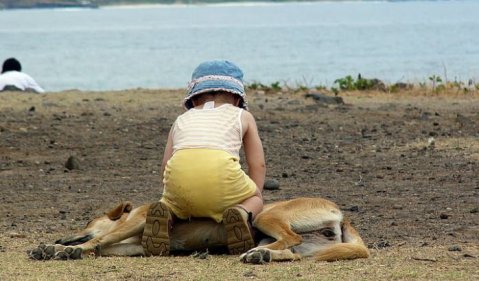
Sitting on the dog, hugging the neck or lying across the body may look adorable in a photo. In practice, it removes the dog’s escape route and adds pressure exactly where many dogs dislike it.
Ignoring early warning signals
A dog usually whispers before he shouts. Turning away, licking lips, freezing or leaving the room are not random quirks. They are the dog saying: “Enough, small human.”
Trusting pretty gear more than functional gear
Some collars look great in photos and fold like warm toast under real pull. When a dog lunges, weak leather, narrow straps or light hardware can twist, dig in or shift. That is not a style problem. That is control leaking out through the buckle.
Expert view
From a gear-maker’s point of view, family safety is never only about training commands. It is also about what happens in that ugly little second when the dog spots a cat, the child runs across the garden, and the leash suddenly goes tight. That moment does not care about catalogue photos. It cares about width, leather, stitching, hardware and whether the person holding the leash can still guide the dog.
Looks matter. Of course they do. But function is the part that keeps the story boring — and boring is beautiful when children and strong dogs share the same space.
Who is this advice for?
- families bringing a puppy into a home with children
- parents whose dog is gentle indoors but strong outside
- owners of Staffies, bull-type dogs and muscular breeds
- people unsure whether a classic collar, harness or half check makes sense
- anyone who wants love at home without leash chaos at the gate
Final summary
A child and a dog can live beautifully together when adults set the rules before problems start. Teach the child to respect space, teach the dog calm behaviour, and do not rely on “he would never do that” as your safety system. If the dog is strong, choose gear that stays stable when the leash goes tight. Love is lovely — control is what keeps it lovely.
Frequently asked questions
Can a child and a dog be left alone together?
No. Even a kind dog and a sensible child need adult supervision, because accidents often happen in seconds.
How do I teach my child to behave around a dog?
Use simple rules: do not wake the dog, do not pull ears, do not touch food, and let the dog leave whenever he wants.
What signs show a dog is uncomfortable with a child?
Freezing, turning away, lip licking, yawning, whale eye or leaving the room are common signs the dog needs space.
Is a strong dog safe around children?
Yes, if the dog is trained, supervised and managed properly. Strength matters because even friendly excitement can knock a child down.
What collar is best when a child helps walk the dog?
A stable, firm collar with correct fit is usually safest for predictable handling. A child should not walk a strong dog alone.
Featured Dogs