Why Traditional Leather Still Defines the Staffy Show Ring
Short answer:
Traditional leather still defines the Staffy show ring because it gives a clean outline, steady handling, and a level of control that flashy but weaker materials often fail to deliver. In a breed where neck, topline, expression, and overall balance matter instantly, the wrong show gear can distract the eye in seconds.
You can have a well-conditioned Staffy, a polished gait, and a solid stack. Then one bad detail wrecks the whole picture. A lead that twists. A loop that slides. A clip that shifts your number sideways. In the ring, tiny mistakes are not tiny. They are loud.
Why does traditional leather still matter in the Staffy show ring?
Traditional leather still matters because it helps the dog look correct while helping the handler stay precise. It is not there to shout. It is there to hold the presentation together.
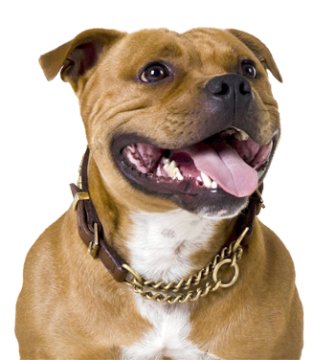
That matters even more with Staffordshire Bull Terriers. This is not a breed that benefits from visual chaos. A Staffy should look compact, balanced, controlled, and ready—not hidden under fussy gear or dragged around by something that behaves like a shoelace.
Good leather also behaves differently in the hand. It has structure. It settles. It does not feel nervous. When the dog steps forward with purpose, you feel the movement sooner and correct it faster, without turning the whole thing into a tug-of-war.
What does a bad show collar ruin first?
The first thing a bad show collar ruins is the line of the dog.
If the set is too bulky, too soft, too shiny, or unstable in motion, the eye stops reading the dog and starts reading the gear. Instead of neck flow and overall balance, people notice distraction. That is a lousy trade.
With a Staffy, that matters fast. This breed is judged on overall impression, not on excuses. If the neck line looks broken, if the head carriage is disturbed, or if the setup keeps drawing attention upward, the finish feels messy even when the dog itself is not.
Why is leather better than “looks good online” gear?
Because the ring is not an Instagram close-up. It is movement, timing, pressure, correction, and presentation under tension.
Some materials look neat in a product photo and then misbehave the second the dog leans forward. They can bounce, bite into coat awkwardly, twist in the hand, or lose that clean visual line once the dog starts moving. Traditional leather usually performs better because it keeps shape and communicates more clearly.
That is exactly why a clean, functional setup such as the Chic Exhibit Show Set makes sense in the ring. It is built around a subtle line and precise presentation, so the focus stays on the dog instead of wandering off to the equipment. The same logic applies to the Bowline Show Set, which is designed around a stable loop and smooth control when you need the neck to stay visually clean and the handling to stay calm. Both product concepts are described by Slade Czech as light, strong, and intentionally non-distracting.
Why does control matter so much if the dog already shows well?
Because even a good dog can give you one dumb second.
A Staffy might step too hard into the lead, lift the head a fraction too high, lean into excitement, or throw a quick sideways reaction when another dog moves nearby. In that moment, your gear needs to answer clearly. Not later. Not eventually. Instantly.
Leather helps because the feedback feels cleaner. You do not need drama. You need one quiet correction and then back to flow. The best ring gear is often the gear the judge barely notices.
What kind of show setup works best for different ring moments?
Different moments ask for different tools.
If you want a minimal line with stable control around the neck, the Chic Exhibit Show Set fits that role well. Slade Czech presents it as a clean show look that keeps the dog perfectly presented without distraction in the ring.
If you want a loop-based solution that stays smooth in handling and keeps the neck visually open, the Bowline Show Set is the more natural fit. Its product description emphasizes a non-slip loop design and consistent control.
And if your number card is the annoying little detail that keeps spoiling the final polish, the Staffy Style Show Clip earns its place. It is meant to keep the number fixed, stable, and visually in tune with the rest of the setup instead of dangling around like an afterthought.
Common mistakes
- Choosing gear that is too visible: If people notice the lead before the dog, something has gone sideways.
- Using soft or unstable material: It may feel harmless until the dog steps into pressure and the setup starts shifting.
- Ignoring proportion: A Staffy needs gear that supports the picture, not gear that cuts the neck line in half.
- Treating the number clip as irrelevant: A loose or awkward clip can break the clean finish of an otherwise polished presentation.
- Picking “pretty” over functional: Pretty that fails in motion is not pretty for long.
Expert view
From a practical point of view, traditional leather keeps winning because it balances visual restraint with handling confidence. That balance matters in real use, not just in theory.
When people talk about “show elegance,” they sometimes drift too far toward decoration and forget the working side of the setup. But the ring is still a live environment. Dogs breathe, brace, anticipate, lean, hesitate, and surge. Gear has to follow that reality.
That is why leather continues to hold its ground. It ages well, holds shape better than many weak alternatives, and gives a more settled, readable feel in the hand. Not flashy. Not flimsy. Just dependable—the old-school way, which is often the smart way.
Who is this solution right for?
- Handlers who want a clean ring picture: less distraction, more dog.
- Staffy owners who value control without visual clutter: especially in movement and stacking.
- People showing short-coated breeds: where every line is visible and bad gear stands out fast.
- Exhibitors who care about matching details: because ring polish lives in the little things too.
- Owners who want gear that works beyond the photo: not just something that looks clever on a screen.
Final summary
Traditional leather still defines the Staffy show ring for a simple reason: it supports the dog instead of competing with it. It keeps the outline cleaner, the handling steadier, and the presentation more believable from the first glance to the final stand.
That does not mean every leather setup is automatically right. It means the right leather setup still beats gimmicks when control, line, and ring presence matter. And in Staffies, they always do.
In the end, the best show gear is not the one that shouts the loudest. It is the one that lets the dog do the talking.
Frequently asked questions
Why is leather still preferred for Staffy show collars?
Because it gives a cleaner look, steadier control, and usually a more reliable feel in motion than weaker or overly decorative alternatives.
Is a thinner show set always better?
No. It needs to look refined, but it still has to stay stable in the hand and on the dog. Too little structure can become a problem fast.
What is the difference between Bowline and Chic Exhibit?
Bowline is better suited to handlers who want a loop-based solution with smooth control and a clear neck line, while Chic Exhibit focuses on a cleaner, subtler presentation that keeps attention on the dog.
Does the show clip really matter?
Yes. A number clip is a small detail, but a shifting or awkward one can disturb the final visual impression. A stable clip keeps the setup looking finished.
Can flashy gear hurt presentation in the ring?
Absolutely. If the equipment pulls the eye away from the dog’s outline, expression, or movement, it works against the presentation instead of helping it.