Wide Collar, Safe Neck
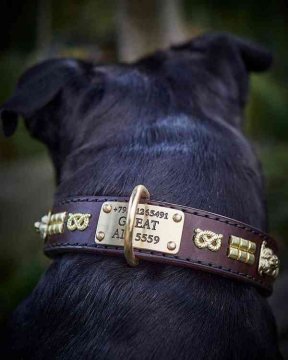
Wide Collar, Safe Neck
Why narrow hurts. And wide makes sense.
A dog’s neck is not a handle. It’s not something you can grab and yank every time something moves at the other end of the leash. The neck is a sensitive structure — where muscles, tendons, the windpipe, and nerves meet. And this is exactly where it’s decided every single day whether a collar works… or quietly causes harm.
When a dog lunges, jerks, or suddenly changes direction, it’s not just a tug in your hand. It’s physics. A force that stops in a split second — right at the neck. A narrow collar has nowhere to send that energy. All the pressure concentrates into a single thin line — it digs in, clamps down, and delivers the impact exactly where the dog feels it most.
A wide collar works differently. It doesn’t stop force at a single point. It spreads it. The pressure is distributed over a larger surface, turning a sharp jerk into a manageable contact.
The difference is huge, even if you don’t see it at first glance. In photos, both collars may look similar. On the dog’s neck, they behave completely differently. A narrow collar cuts in, slides, and twists. A wide collar holds its shape, stays calm, and gives the neck room to move naturally.
The dog breathes more freely, movement feels less harsh, and every next step is just a bit calmer.
With strong, muscular breeds, this matters twice as much. Staffies, bullies, or bulldogs are no porcelain figurines. They have short necks, massive muscles, and movement that can be explosive. When such a dog pulls, it’s not a gentle tug. It’s a rapid transfer of force.
And this is exactly where it shows whether a collar has the width to protect the neck, or whether it’s just a narrow strip of material trying to handle something it was never built for.
We often hear that narrow collars look more elegant. Sure. For five minutes. For a photo. For a show ring. But a dog doesn’t wear a collar for five minutes. It wears it every day. In the city, off-road, on normal walks.
And beauty that hurts isn’t style. It’s a compromise that will speak up sooner or later. Maybe not today. Maybe months from now. But it will.
A well-designed wide collar doesn’t have to be heavy or bulky. When properly shaped and balanced, it sits calmly, doesn’t get in the way, and the dog barely knows it’s there.
The problem isn’t width. The problem is bad design pretending to be robust while solving nothing at all.
A dog has only one neck. And a collar should do exactly what it’s meant to do: protect, not punish. Spread force instead of concentrating it. Work in the real world, not just on a product photo.
A wide collar is not a fashion trend. It’s not a marketing trick. It’s a basic safety feature that makes sense every time the leash tightens and the dog decides to move his way.