Loose Dog Charging? This Is Where Control Starts
Short answer:
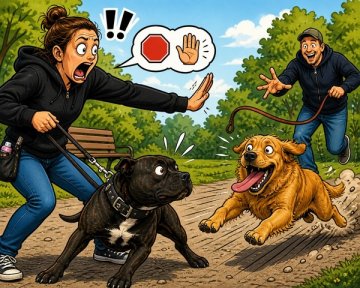
When another dog rushes your dog, your first job is to control the space, not the conversation. Step away, block the line, give the other owner a clear instruction, and keep your own dog from feeling pinned at the end of the leash.
A strong dog does not need sidewalk drama. He needs a handler with a plan and gear that stays steady when the leash suddenly goes tight. If the collar rolls, folds, or slides the moment pressure hits, you are already playing catch-up.
What should you do when an off-leash dog comes straight at yours?
Act before the dog reaches you. Change direction, put your body between the dogs, shorten the leash without jerking, and say clearly: “Please call your dog.” The safest greeting is the one both dogs and both people actually agree to.
This is where many walks go wrong. The loose dog is “friendly,” the owner is twenty yards away, and your dog is stuck on a leash with no clean exit. If your dog is a strong breed or a heavy puller, this is also where equipment gets exposed fast. The article on choosing a collar for a strong Staffordshire Bull Terrier is a useful next read if your current setup feels fine on quiet walks but messy when pressure hits.
What do you say to the owner of the loose dog?
Say one thing, clearly: “Please call your dog back.” Do not negotiate while the dogs are closing distance.
Long explanations waste the exact seconds you need. Your dog may already be watching the incoming dog, stiffening through the shoulders, or loading forward into the leash. A short instruction gives everyone a chance to reset before the situation gets noisy.
Should a leashed dog meet a dog that is running free?
Not by default. A leashed dog is at a disadvantage because he cannot choose distance naturally.
When a free dog charges in, even with happy body language, the leashed dog may feel boxed in. That is when you see the quick signs: head turns away, body stiffens, tail changes, barking starts, or the dog plants his feet. That is not your dog being difficult. That is your dog saying the setup is bad.
How can you make space fast?
Use simple movement. Turn around, step behind a barrier, move off the path, or put yourself between the dogs.
A practical “behind me” cue is worth gold here. Your dog moves behind your leg, you hold the leash shorter but calm, and the approaching dog meets you first. No theatre. No hero pose. Just a clean boundary before the situation grows teeth.
Why does collar stability matter in these moments?
Because pressure changes everything. A collar that behaves on a calm dog may fail the moment the dog lunges sideways or drives forward.
Use the 5-second check: your dog leans into the leash, and the collar either stays flat and stable or turns 90°, rolls into a rope, or digs pressure into one narrow line. If it does the second thing, the collar is not just “a bit soft.” It is making handling slower and rougher.
For a dog that walks mostly steady, a solid classic leather collar for controlled daily walks may do the job. If your dog backs out, slams into the leash, or tests every inch of space, a properly fitted leather half check collar can be a better tool when matched with calm handling.
Decision flow: what fits your dog?
- If your dog is steady but strong: use a firm classic collar that holds shape and gives clear leash feedback.
- If your dog spins, braces, or drives forward hard: check width and construction before blaming the dog alone.
- If your dog backs out or hits the leash like a little tank: consider a half check collar with correct sizing.
- If you are unsure: watch the collar under real pull. Rotation, folding, and one-line pressure tell the truth fast.
If leash pulling is the bigger pattern, do not solve only the equipment side. The next step is understanding the habit itself in how to stop a strong dog from pulling on leash, then matching the training with gear that does not fight against you.
Common mistakes
Letting the loose dog get too close before reacting
The mistake is waiting because you do not want to seem rude. By the time the dog is right in front of you, your dog may already be stiff, trapped, and ready to answer for himself.
Arguing while the dogs are still in motion
The mistake is trying to fix the owner before you fix the space. Handle the dogs first. You can be annoyed later. Your dog needs your timing now.
Trusting gear that only looks good standing still
A soft, narrow collar can look neat in product photos or on a calm dog at the door. Under a real lunge, it can twist, fold, and pull pressure into one harsh strip. You feel the leash angle go bad, the dog’s neck position changes, and suddenly the walk feels like damage control.
Thinking every greeting teaches social skills
Random greetings are not training. If your dog is forced into every approach, he may learn that the leash means being stuck while other dogs invade his space.
Good-looking gear versus working gear
Pretty gear is easy to judge when nothing is happening. Working gear proves itself when the dog fires forward, braces sideways, or loads the leash with his full body. The difference is simple: decoration photographs well; function keeps the dog with you.
Expert view
In real handling, small gear failures create big timing problems. A collar that stays open, flat, and stable gives the handler cleaner information. A collar that collapses forces the dog and handler into a blur of pressure. That blur is where many “bad reactions” get worse.
Standing up for your dog is not about being the loudest person on the path. It is about being the clearest one. Your body, leash, voice, and equipment should all say the same thing: we are not doing chaos today.
Who is this for?
- Dogs that dislike direct approaches from unfamiliar dogs.
- Strong dogs that can move a handler with one hard pull.
- Owners who want fewer forced greetings and fewer awkward leash moments.
- Dogs that need structure before social contact.
- Handlers who want calm control without turning every walk into a street debate.
Final summary
Back your dog up early. Move, block, speak clearly, and leave before the moment turns into a scene. If your dog is powerful, make sure the collar stays stable when the leash goes tight, because that is when real control is tested. A calm walk is not luck; it is a plan that works before the first bark.
Your next step is simple: decide whether the problem is training, distance, gear stability, or all three. If the collar shifts under pressure, fix that before expecting perfect handling.
Frequently asked questions
What should I do when another dog runs toward my dog?
Create distance, step between the dogs, and tell the owner to call their dog back. Act early rather than waiting for contact.
Is my dog wrong for reacting to an off-leash dog?
Not necessarily. A leashed dog may react because he feels trapped, especially when another dog runs straight at him.
How can I protect a strong dog on leash?
Use distance, calm handling, and stable gear. A collar that twists or folds under pressure can make a strong dog harder to guide.
Does collar width matter for leash control?
Yes. Width and construction affect how pressure spreads and whether the collar stays stable during sudden movement.
When should I consider a half check collar?
Consider it when a dog backs out, tests the leash, or hits the end of the lead hard, but only with correct fit and responsible handling.