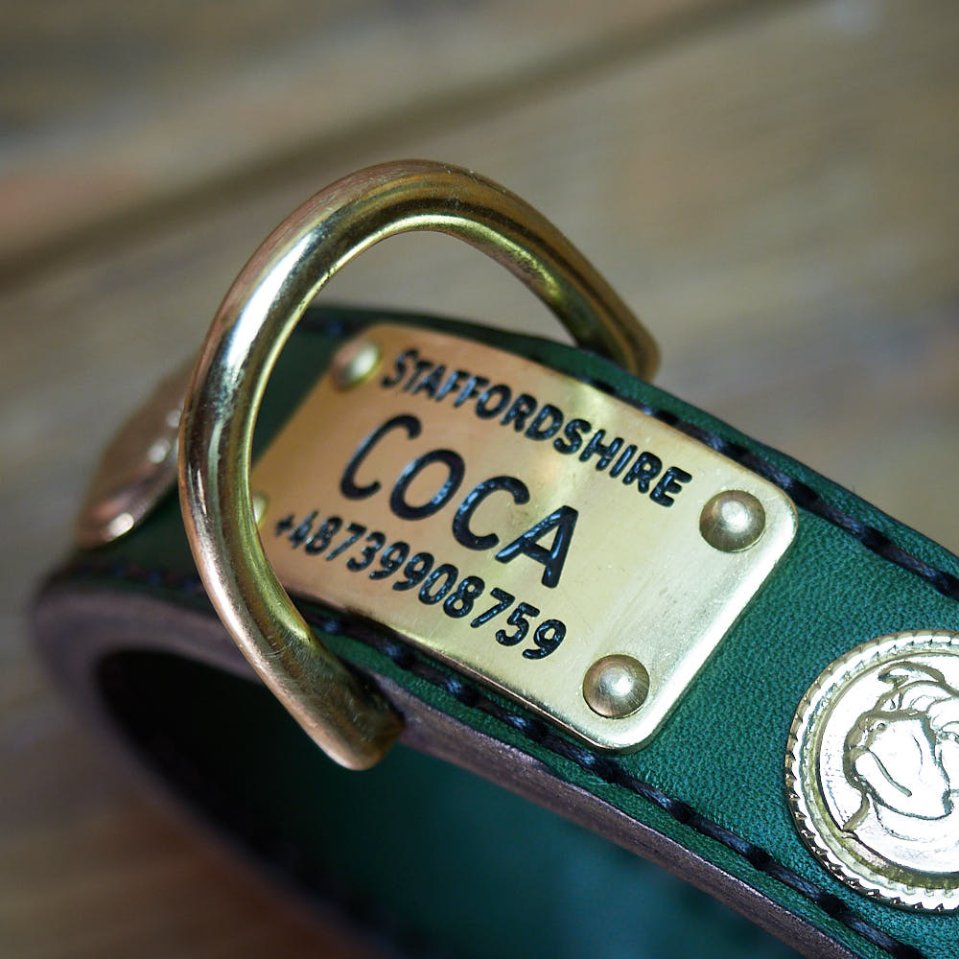
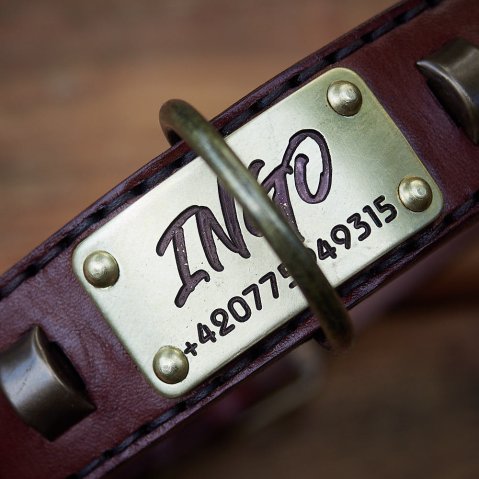
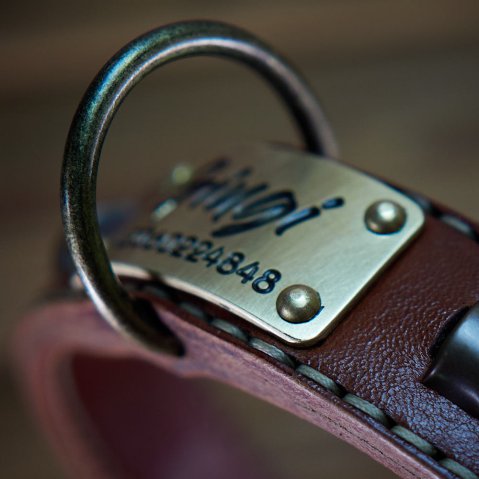
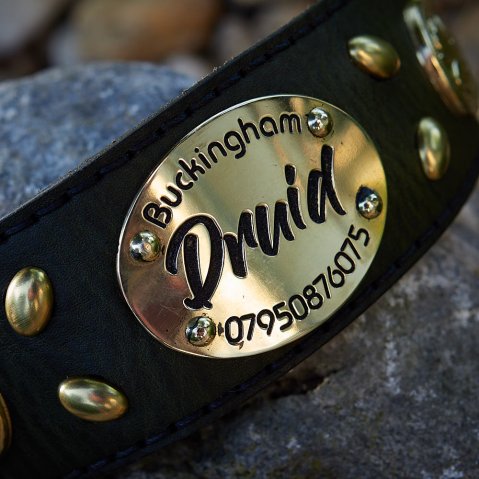
Label for Label: swap the dog ID plate, keep the collar ready for real life
Short answer:
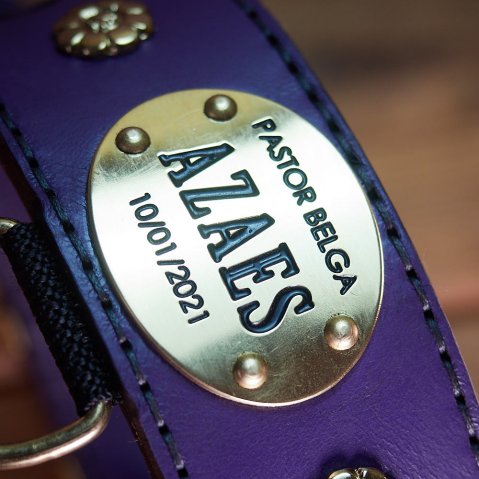
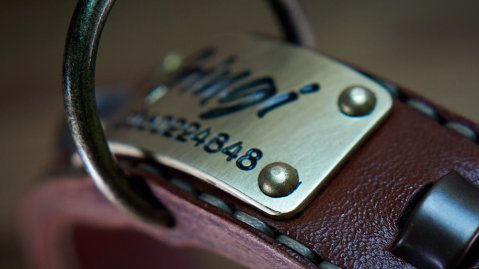
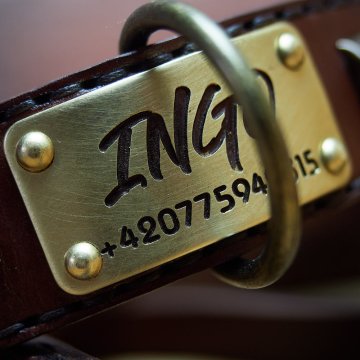
Label for Label is made for one job: update the ID plate on a collar that still has miles left in it. Send the collar in, we replace the old plate with a new one, fit it properly, and send it back ready for daily leash work. The new plate cannot be bigger than the original, because the leather has a real structure, not unlimited space.
How do you update a dog collar ID plate without replacing a good collar?
If the leather collar is still strong, do not throw it out just because your phone number changed. With Label for Label, we swap the old fixed ID plate for a new one and keep the collar usable, clean and ready for real-life handling.
This matters most on gear that actually gets used. A handmade leather dog collar on a strong dog takes pressure, movement and leash chaos. If the plate is outdated, the collar can still do its job — but the information cannot. For a broader setup, check the full range of dog tags; for a fixed plate on an existing collar, Label for Label is the direct route.
When is Label for Label the right move?
Use Label for Label when the collar is still solid, but the engraved information is wrong.
New phone number. New address. New owner name. Dog renamed after a family debate that got way too serious. The leather collar may still hold under pressure, the buckle may still sit right, and the stitching may still be doing its job. The only weak point is the outdated ID plate. Fix that part, not the whole collar.
Why can’t the new plate be larger?
The new ID plate must match the space of the old one because the collar already has a fixed shape, hardware position and leather curve.
Here is the five-second test: if the plate is too big, it does not sit cleanly. It pushes toward the edge, fights the leather curve or makes the collar look forced. On a table, bigger may look better. On a dog that lunges, turns, shakes and pulls like he pays rent, bigger can become dumb fast.
What goes wrong with weak ID setups?
Cheap or badly placed ID gear can twist, slap against hardware, hide under the neck or become hard to read when the dog actually moves.
A collar for strong pullers is not tested in a quiet product photo. It is tested when the dog sees a squirrel, hits the end of the leash and the collar rotates under load. That is where “looks good” and “works in real life” split hard. Dog gear that holds under pressure needs identification that stays useful under pressure too.
Fixed ID plate or hanging dog tag?
A fixed plate keeps the collar clean and stable. A hanging tag is easier to move between collars and works well as a separate visible ID.
If your strong dog collar already has a fixed label, Label for Label keeps that setup alive. If you want a separate tag, the Plate Dog Tag gives a clear, strong shape, while the Circle Dog Tag is a simple visible option for everyday use. Pick the system that matches how your dog actually wears gear, not how calm he looks for six seconds indoors.
Decision flow: pick the right ID setup
- If your leather collar for powerful dogs still works but the details are wrong, use Label for Label.
- If you need a separate tag you can move between collars, choose a durable option like the Military Dog Tag.
- If you want a softer shape with more visual personality, compare the Bell Dog Tag and Victory Dog Tag.
- If your dog is a runner, add an AirTag Wrap as backup, not as a replacement for readable ID.
- If you are unsure, solve the basics first: visible contact details, correct plate size, secure fit and real leather dog gear that does not fold under normal pulling.
Common mistakes
Going bigger because the plate looks tougher
A larger plate can look heavy-duty in a photo and still be wrong for the collar. If it does not match the original space, it may push the leather out of line or sit too close to the edge. That is not an upgrade. That is a metal ego problem.
Thinking a microchip is enough
A chip is useful, but someone needs a scanner. A visible tag or plate gives a fast answer on the street, at a park gate or in front of a neighbor’s house. Read 5 reasons why your dog needs a tag even with a microchip if you want the full safety logic.
Ignoring real leash pressure
Strong dogs do not wear gear like mannequins. They pull forward, spin sideways, shake off rain and test every weak point. A heavy-duty leather collar can handle work, but the ID setup still needs to stay readable and placed where a person can actually find it.
Leaving dead information on a working collar
An old phone number is not “close enough.” It is useless when somebody is trying to get your dog home. If your dog slips out, the person holding the leash should not need detective skills and three apps to reach you.
Expert view
Replacing a collar plate is a small job with real consequences. The new plate has to fit the leather, respect the existing space and sit correctly when the collar bends around the neck.
This is the same rule we use for any leather dog gear for real-life use: the photo does not get the final vote. The dog does. If the collar twists 90 degrees under pressure, if the plate catches on hardware, or if the information ends up hidden under the throat, the setup failed where it matters. Good identification is quiet until it is needed — then it needs to speak fast.
For more on the metal side of the story, read Art that smells like brass. If you are building the whole setup from the collar outward, personalised dog collars from Slade Czech show how ID, leather and hardware can work together instead of fighting for space.
Who is this for?
- For owners who changed phone number, address or dog details.
- For dogs wearing a handmade leather dog collar that is still strong enough for daily use.
- For Staffy collar setups where the fixed plate is part of the clean collar build.
- For people who want real ID on real leather dog gear, not a loose afterthought rattling around.
- For strong pullers, busy walkers and escape-minded dogs where readable information is not optional.
Next step: build the full safety setup
If you are updating the plate because your dog has already pulled a disappearing act, read what to do when your dog gets lost. If you want tracking backup, go through how AirTag works for tracking pets. The strongest setup is not complicated: readable ID on the dog, tracking as backup, collar built to stay in the fight.
Conclusion
Label for Label keeps a good collar working when only the contact details need a reset. It is practical, clean and better than replacing strong gear for one outdated line of text. Keep the new plate the right size, keep the information readable and keep the collar ready for real use. When the dog pulls, runs or invents chaos, the ID should not become part of the problem.
Frequently asked questions
Can I update the ID plate on my dog’s leather collar?
Yes. Send the collar in and we replace the old fixed plate with a new engraved one.
Can the replacement plate be bigger?
No. The new plate must not be larger than the original because it may not fit the collar correctly.
Is Label for Label good for strong dog collars?
Yes, if the collar itself is still solid and only the ID information needs changing.
Do I still need a dog tag if my dog has a microchip?
Yes. A visible tag or plate helps someone contact you without needing a scanner.
Should I use an AirTag instead of a dog ID plate?
No. An AirTag can help track location, but readable contact details should still be on the dog.
What is better: fixed plate or hanging dog tag?
A fixed plate gives a cleaner collar build. A hanging tag is easier to move between collars.
Real Dogs