AmStaff Growth Chart: Puppy Weight, Adult Size, and Collar Fit
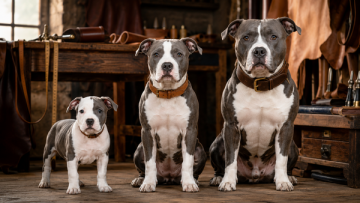
Quick answer: A full-grown American Staffordshire Terrier usually stands about 17–19 inches tall. Adult males commonly weigh around 55–70 pounds, while females often weigh approximately 40–60 pounds. Most AmStaffs reach nearly their full height by 12–15 months, but their chest, neck, and muscle development can continue filling out until roughly 18–24 months.
Your AmStaff puppy starts out as a warm little bundle with oversized opinions. Then one day a squirrel cuts across the sidewalk, the leash goes tight, and you realize that bundle now comes with horsepower.
That is why growth tracking matters. It tells you more than whether your dog is getting bigger. It helps you monitor healthy development, protect growing joints, recognize when the collar no longer fits, and prepare for the adult dog arriving faster than expected.
How big does a full-grown AmStaff get?
American Staffordshire Terriers are muscular, athletic dogs with strong bone, broad chests, and substantial necks. Official breed guidance emphasizes proportion. It does not prescribe one exact body weight that every healthy AmStaff must reach.
- Adult male height: about 18–19 inches.
- Adult female height: about 17–18 inches.
- Typical adult male weight: around 55–70 pounds.
- Typical adult female weight: around 40–60 pounds.
- Common adult neck measurement: approximately 16–22 inches.
These numbers describe useful ranges, not a pass-or-fail test. A dog’s frame, muscle, waistline, movement, and overall health matter more than bragging rights at the scale.
If you are trying to tell an AmStaff from its smaller British relative, our breakdown of the differences between an American Staffordshire Terrier and a Staffordshire Bull Terrier explains what changes once you move beyond the broad head and confident expression.
AmStaff puppy weight chart: 2 through 18 months
Use the following numbers as approximate growth ranges, not official breed-standard requirements or veterinary targets. Bloodline, sex, parental size, nutrition, and individual development can shift a healthy puppy above or below these estimates.
- 2 months: female about 9–13 lb; male about 11–15 lb.
- 3 months: female about 13–20 lb; male about 15–24 lb.
- 4 months: female about 20–29 lb; male about 24–35 lb.
- 5 months: female about 26–35 lb; male about 31–44 lb.
- 6 months: female about 31–42 lb; male about 37–51 lb.
- 7 months: female about 35–46 lb; male about 42–57 lb.
- 8 months: female about 37–51 lb; male about 46–62 lb.
- 9 months: female about 40–53 lb; male about 49–66 lb.
- 10 months: female about 40–55 lb; male about 51–68 lb.
- 11 months: female about 42–57 lb; male about 53–71 lb.
- 12 months: female about 42–60 lb; male about 53–73 lb.
- 15 months: female about 42–62 lb; male about 55–75 lb.
- 18 months: female about 42–64 lb; male about 55–77 lb.
A growth chart helps you spot patterns. It should never become a reason to overfeed a perfectly healthy puppy just to hit somebody else’s number.
What if your AmStaff puppy is smaller?
A smaller puppy can still be completely healthy if growth remains steady, energy is normal, the ribs are easy to feel, and the dog maintains a visible waist.
Watch the trend rather than panicking over one weigh-in. Genetics can produce a leaner dog without creating a medical problem.
However, weight loss, poor appetite, persistent diarrhea, weakness, or stalled growth deserve a veterinarian’s attention. A puppy that stops progressing while also acting unwell needs more than a bigger scoop of kibble.
What if your puppy is heavier than the chart?
A heavier puppy may come from a larger-framed line. The concern is excess body fat, not a number by itself.
If you cannot feel the ribs without pushing, the waist disappears, or the puppy starts moving like a loaded shopping cart instead of a young athlete, have a veterinarian assess body condition and feeding.
More weight does not automatically mean more muscle. Sometimes it just means more stress on growing joints.
Male and female AmStaffs: what is actually different?
Male AmStaffs are often taller, heavier, broader through the shoulders, and thicker through the neck. Females frequently stay lighter and may mature a little earlier, but individual overlap is common.
A stocky female can need a larger collar than a narrow young male. That is why ordering based only on sex makes about as much sense as buying a helmet based on your motorcycle’s paint color.
Real-life strength shows up when your dog spots another dog across the street, lunges toward a tennis ball, leans into the leash outside a store, or suddenly decides the neighbor’s cat needs a formal introduction.
When do AmStaffs stop growing?
Height comes first, substance comes later
Many American Staffordshire Terriers reach most of their adult height between 12 and 15 months. Their chest, neck, and muscle mass can keep developing until approximately 18–24 months.
That means a one-year-old dog may still look like a teenager: long enough, strong enough, but not fully filled out.
Growth can look uneven
A puppy may suddenly grow longer legs, then broaden through the chest, then develop a thicker neck months later. That awkward middle stage does not automatically signal a problem.
Repeated limping, stiffness, difficulty standing up, or a clear reluctance to move are different. Those are reasons to call the vet rather than wait for the dog to grow out of it.
Protect developing joints
Keep exercise age-appropriate. Controlled play, normal walks, and sniffing adventures are generally more sensible than repetitive hard jumping, forced distance running, or intense impact work with an immature dog.
A puppy can look tough long before the body is ready for adult-level workloads.
How to tell whether your AmStaff is at a healthy weight
Veterinary body-condition scoring commonly uses a nine-point scale. Many healthy dogs fall around 4–5 out of 9, where the dog looks athletic without appearing bony or padded.
- Look from above: the waist narrows behind the rib cage.
- Look from the side: the abdomen tucks upward.
- Use your hands: you can feel the ribs without digging through a thick layer of fat.
- Watch movement: the dog walks comfortably, changes direction smoothly, and does not fatigue unusually fast.
A broad chest is part of the breed. A disappearing waist is not a badge of honor.
Track your puppy’s weight consistently, check body shape regularly, and discuss food portions with your veterinarian. Avoid adding calcium, muscle-building supplements, or extra calories without professional guidance.
AmStaff versus Staffy: spot the difference fast
A Staffordshire Bull Terrier generally stands around 14–16 inches and commonly weighs roughly 24–38 pounds. An American Staffordshire Terrier usually stands around 17–19 inches and often carries substantially more overall mass.
Think compact spring versus bigger athlete. Both can pull harder than strangers expect, but the larger dog usually brings more body weight and leverage to the leash.
The difference matters when a rabbit breaks cover, a delivery truck rattles past, or a loose dog comes around the corner. A collar can look perfect while your dog stands still. The real test starts when stillness leaves the building.
How to measure your AmStaff for the right collar
Measure your dog’s actual neck where the collar normally rests. Use a flexible tape and leave enough room for approximately one or two fingers without creating a loose gap.
- Have your dog stand comfortably.
- Wrap the tape around the middle of the neck.
- Keep it snug but not tight.
- Record the measurement in inches or centimeters.
- Select the matching neck size instead of guessing from the collar’s total length.
Slade Czech classic collars are sized so the selected neck measurement corresponds to the middle hole. That gives adjustment room without leaving the collar loose enough to twist or slide over the head.
Growing puppies need frequent fit checks. Our article on choosing a puppy collar that fits safely from day one explains what to watch for before that first serious growth spurt.
Instant reality check: if the collar rotates, rides up toward the ears, leaves marks, or shifts under tension, reassess the size and width.
What collar works at each growth stage?
Young puppy: start light
A small puppy needs low weight, comfortable movement, and a collar that fits the neck it has today. Oversized adult gear can interfere with movement or slip off.
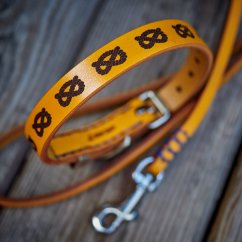
The Baby Doll puppy collar and leash set comes in 13 mm and 16 mm widths, approximately 0.51 and 0.63 inches. It is intended for calm first walks and gentle leash introductions, not hard pulling or forceful handling.
Growing adolescent: everyday structure without unnecessary bulk
An adolescent AmStaff needs equipment that fits the growing neck, stays stable during ordinary walks, and does not add pointless weight.
The Smart Casual everyday leather dog collar uses a straightforward hand-stitched design without excessive decorative hardware. It is a practical everyday option, but it will not magically teach a dog to stop pulling.
Powerful adult: match the collar to the dog
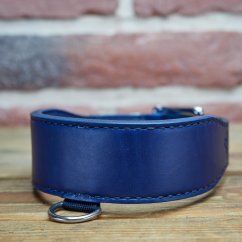
Many adult AmStaffs do well with collars around 40–50 mm wide, roughly 1.6–2 inches, as long as the dog’s neck length and overall structure support that width comfortably.
The Beefy Bang Bang wide leather collar for strong dogs is available in 32 mm, 40 mm, and 50 mm widths. That gives owners several practical options instead of pretending every adult dog needs the same oversized setup.
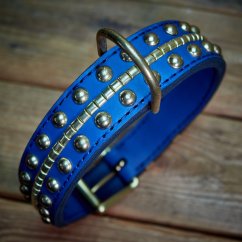
A wider, well-fitted collar can improve stability and spread contact across more surface area. It cannot prevent all neck strain, eliminate lunging, or replace training. If your dog pulls hard or shows throat sensitivity, work with your veterinarian or a qualified trainer on safer handling.
Choose based on the dog in front of you
- Small puppy learning the leash: use lightweight puppy equipment and check fit often.
- Teenage AmStaff growing quickly: remeasure the neck and choose a stable everyday collar.
- Broad, powerful adult: consider a properly fitted collar around 1.6–2 inches wide when appropriate.
- Collar keeps twisting or riding up: check neck size, width, and the dog’s head-to-neck proportions.
- Dog repeatedly lunges or pulls: work on triggers and training; gear helps management but does not change behavior on its own.
- Weight changes suddenly or movement looks painful: call your veterinarian before changing food or exercise aggressively.
Mistakes AmStaff owners should avoid
Do not buy a collar several sizes too large so the puppy can grow into it. A loose collar can rotate, snag, or slide over the head at exactly the wrong moment.
Do not keep an increasingly powerful adolescent in a delicate starter collar after the dog has outgrown its purpose. Cute stops being helpful when the leash snaps tight.
Do not push extra food simply because someone online says an AmStaff should weigh more. The dog’s waist, ribs, and movement tell you more than somebody else’s internet trophy photo.
And do not expect a tougher collar to replace training. Strong gear manages force. Training changes what the dog does with that force.
When to get professional help
Contact your veterinarian if your puppy stops gaining weight, loses weight, develops ongoing diarrhea, limps repeatedly, struggles to stand, becomes unusually tired, or reacts painfully around the neck.
Talk to a qualified reward-based trainer when walks feel unsafe, your dog repeatedly charges toward people or other dogs, or excitement turns into persistent pulling and lunging.
If a previously comfortable dog suddenly starts resisting the collar or reacting differently, rule out pain before assuming the issue is disobedience.
Frequently asked questions
How much should a six-month-old AmStaff weigh?
A six-month-old female may weigh around 31–42 pounds, while a male may weigh roughly 37–51 pounds. These figures are approximate, not required targets.
When is an American Staffordshire Terrier fully grown?
Many AmStaffs reach most of their adult height by 12–15 months, while muscle and overall body development may continue until approximately 18–24 months.
What size is an adult AmStaff’s neck?
Adult AmStaff neck size often falls around 16–22 inches, but individual measurements vary. Always measure your own dog before ordering a collar.
Does a heavier AmStaff mean a healthier dog?
No. Healthy body condition depends on muscle, structure, movement, and a visible waist. Extra body fat can increase stress on the joints.
How wide should an adult AmStaff collar be?
Many adult AmStaffs do well with collars approximately 1.6–2 inches wide, although smaller dogs or dogs with shorter necks may need a narrower collar.
Can an AmStaff puppy wear a full-size adult collar?
A puppy should not wear an adult collar that is too heavy, too wide, or loose enough to slip off. Choose equipment sized for the puppy’s current neck.
Forget the biggest number. Focus on the right fit.
Your AmStaff does not need to become the heaviest dog on the block. The goal is steady growth, sound movement, healthy body condition, and equipment that fits when real life suddenly gets interesting.
Measure the neck, choose the right construction, and explore handmade leather collars built for strong dogs and growing AmStaffs. Good gear does not need to look intimidating on your kitchen table. It needs to hold up when the squirrel makes its move.