Amstaff Growth Chart: Weight, Height and Collar Size From Puppy to Adult
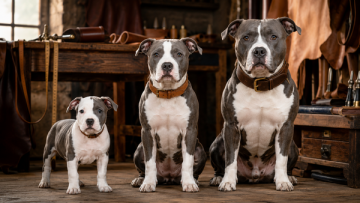
Short answer: An adult American Staffordshire Terrier usually stands approximately 43–48 cm at the shoulder. Males commonly weigh around 25–32 kg, while females often weigh approximately 18–27 kg, although healthy individuals may fall outside these ranges. Most reach their adult height at roughly 12–15 months, then continue developing muscle and body substance until approximately 18–24 months.
At eight weeks, your Amstaff may fit neatly beside your feet. A few months later, the same puppy spots a pigeon, plants its shoulders and suddenly explains why lead fittings deserve closer inspection. Growth is not just about numbers on the scales. It affects joints, feeding, handling, neck size and the equipment you trust outside.
The useful question is not simply how heavy your dog should be. It is whether your particular dog is growing steadily, staying lean and wearing equipment suited to its current body rather than its imagined future.
How big does an adult Amstaff get?
The American Staffordshire Terrier is a muscular, medium-sized dog with substantial bone, a broad chest and an athletic build. Breed standards prioritise balance and proportion rather than setting one compulsory weight.
- Adult male height: approximately 46–48 cm at the shoulder.
- Adult female height: approximately 43–46 cm at the shoulder.
- Typical male weight: approximately 25–32 kg.
- Typical female weight: approximately 18–27 kg.
- Common adult neck circumference: approximately 40–55 cm, depending on sex, muscle and individual structure.
A powerful 28 kg Amstaff can be in excellent condition. A 35 kg dog can also be healthy if its frame supports that weight, but excess body fat should never be mistaken for impressive muscle.
If you are comparing breeds rather than individual dogs, our explanation of the real differences between the Staffordshire Bull Terrier and the American Staffordshire Terrier shows why similar-looking heads can sit on very different bodies.
Amstaff puppy weight chart: 2–18 months
These figures are broad practical estimates, not an official breed-standard growth chart or a veterinary target. Genetics, parental size, sex, diet and individual development all influence the result. A steady growth trend and healthy body condition matter more than matching a particular row.
- 2 months: female approximately 4–6 kg; male approximately 5–7 kg.
- 3 months: female approximately 6–9 kg; male approximately 7–11 kg.
- 4 months: female approximately 9–13 kg; male approximately 11–16 kg.
- 5 months: female approximately 12–16 kg; male approximately 14–20 kg.
- 6 months: female approximately 14–19 kg; male approximately 17–23 kg.
- 7 months: female approximately 16–21 kg; male approximately 19–26 kg.
- 8 months: female approximately 17–23 kg; male approximately 21–28 kg.
- 9 months: female approximately 18–24 kg; male approximately 22–30 kg.
- 10 months: female approximately 18–25 kg; male approximately 23–31 kg.
- 11 months: female approximately 19–26 kg; male approximately 24–32 kg.
- 12 months: female approximately 19–27 kg; male approximately 24–33 kg.
- 15 months: female approximately 19–28 kg; male approximately 25–34 kg.
- 18 months: female approximately 19–29 kg; male approximately 25–35 kg.
Do not force a smaller puppy towards the upper end of the range. A growth chart is a map, not an order form for extra kilograms.
What if your puppy weighs less than the chart suggests?
A lighter puppy is not automatically underweight. Look for palpable ribs with a light fat covering, normal energy, consistent appetite, appropriate stools and gradual progress over several weeks.
However, poor appetite, repeated diarrhoea, obvious muscle loss, lethargy or failure to gain weight justify a veterinary assessment. One weigh-in rarely tells the full story. A falling trend combined with symptoms tells a much clearer one.
What if your puppy weighs more?
A heavier puppy may simply have larger parents or a stronger frame. Trouble begins when the waist disappears, ribs become difficult to feel and movement starts looking heavy rather than athletic.
Rapid weight gain does not build a better Amstaff. It can place unnecessary demands on developing joints and make everyday movement less comfortable.
Male versus female: what changes in practice?
Males are often taller, heavier and broader through the head, chest and neck. Females commonly have a slightly lighter frame and may reach physical maturity earlier. Individual dogs can overlap considerably, so sex alone cannot predict collar size.
Picture two six-month-old puppies meeting outside a café. The male already looks like he is preparing for rugby trials; the female moves more lightly but can still accelerate towards a dropped sandwich with alarming professional commitment. Both need equipment fitted to their own neck, not to assumptions about their sex.
When does an Amstaff stop growing?
Height usually settles before muscle does
Many Amstaffs reach most of their adult height between 12 and 15 months. Their chest, neck and overall muscle development can continue changing until approximately 18–24 months.
This is why a one-year-old dog may look leggy and unfinished, then appear noticeably broader several months later without becoming much taller.
Growth does not happen in a straight line
Puppies often develop in phases. Legs lengthen, the chest catches up, the neck thickens and proportions settle later. Temporary awkwardness is common; persistent limping, reluctance to rise or repeated stumbling are not details to dismiss.
Young joints still need sensible management
Allow age-appropriate movement, sniffing and controlled play, but avoid repeatedly pushing a growing dog into forced endurance, hard repetitive jumping or intense impact activity. A muscular appearance does not mean the skeleton has finished developing.
How to recognise a healthy body condition
For many dogs, an ideal body condition falls around 4–5 on a nine-point body-condition scale. The aim is visible shape and easily assessed ribs, not exposed bones or a barrel-shaped body.
- From above: a visible waist appears behind the ribcage.
- From the side: the abdomen rises gently rather than hanging level with the chest.
- By touch: ribs are easy to feel beneath a modest layer of tissue without pressing hard.
- In motion: the dog moves freely without tiring unusually quickly or avoiding ordinary activity.
Broad shoulders are not proof of obesity. Equally, a thick neck is not automatically muscle. Hands and movement reveal what a photograph often hides.
Weigh young puppies regularly under consistent conditions, monitor their waist and discuss feeding changes with your vet. Avoid adding calcium, growth supplements or extra portions simply because an online chart makes your dog look small.
Amstaff versus Staffy: the size difference in five seconds
The Staffordshire Bull Terrier is generally shorter and lighter. Adult Staffies commonly stand approximately 35–41 cm and typically weigh around 11–17 kg, while Amstaffs usually stand approximately 43–48 cm and frequently weigh considerably more.
The quick visual version: a Staffy resembles a compact spring; an Amstaff looks like the same athletic idea drawn on a larger frame.
That difference becomes obvious when a cyclist appears unexpectedly, another dog rounds the corner or a squirrel crosses the path. Greater body mass creates greater handling demands. Physics does not care whether the collar looked handsome in the product photo.
How to measure an Amstaff’s neck correctly
Measure the actual dog around the middle of the neck, where a normal collar sits. Use a soft measuring tape, hold it comfortably against the coat and allow approximately one to two fingers underneath without creating a loose loop.
- Ask the dog to stand naturally.
- Place the tape around the middle of the neck.
- Check that the tape is snug but not restrictive.
- Record the measurement in centimetres.
- Choose the corresponding neck measurement rather than guessing the total collar length.
Slade Czech classic collars are sized so the stated neck measurement corresponds to the middle adjustment hole. That gives useful room in both directions without ordering an oversized collar that can rotate or slip.
A puppy can change quickly, so check the fit every few days during fast growth and remeasure before ordering. Our practical explanation of how to choose a properly fitted first puppy collar covers the early stage in more detail.
Five-second fit check: if the collar twists sideways, presses into one narrow line, leaves marks or threatens to slide over the head, the fit needs attention.
What collar width suits an Amstaff?
Young puppies need light equipment first
A small puppy needs a lightweight collar that does not restrict movement or drag down the neck. Width must match the individual puppy’s size and the handling situation.
The Baby Doll puppy collar and lead set is offered in 13 mm and 16 mm widths and suits calm early introductions. It is not designed for hard pulling, force-based handling or an adolescent Amstaff launching after a bird.
Adolescents need sensible everyday stability
A growing adolescent often benefits from a practical collar that remains stable without unnecessary bulk. Select the width and construction according to the actual neck, current strength and available product options.
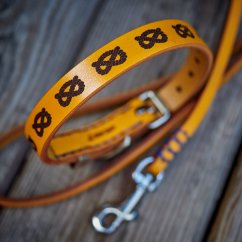
The Smart Casual everyday leather dog collar offers a clean, hand-stitched design without excessive decorative hardware. It suits ordinary walks and daily handling, but no collar alone teaches loose-lead walking.
Powerful adults need proportionate width and dependable construction
Many adult Amstaffs are well suited to collars around 40–50 mm, provided that the width matches their neck length and does not restrict comfortable head movement. A shorter-necked or smaller dog may need a narrower option.
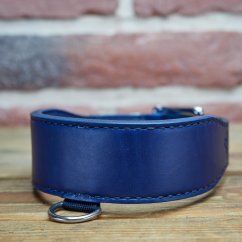
The Beefy Bang Bang leather collar for powerful adult dogs is available in 32 mm, 40 mm and 50 mm widths. That makes it useful when matching a strong adult dog’s actual build rather than assuming every Amstaff needs the widest possible collar.
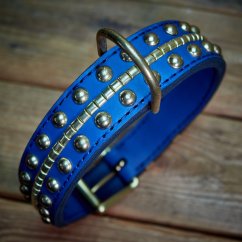
A wider collar can improve stability and distribute contact across a larger area, but it does not make pulling safe or replace training. If the dog repeatedly lunges or has throat sensitivity, discuss appropriate equipment and training with a qualified professional.
Which option fits your dog right now?
- Small puppy learning its first calm walks: choose lightweight puppy equipment and check fit frequently.
- Growing adolescent with increasing neck size: measure the neck again and choose stable everyday construction.
- Broad, powerful adult: consider a proportionate 40–50 mm collar with suitable construction and secure hardware.
- Collar rotates or slips towards the ears: reassess fit, width and head-to-neck proportions.
- Dog pulls continuously or reacts strongly: address training and triggers; equipment improves management but does not change behaviour by itself.
- Weight changes abruptly or movement becomes uncomfortable: consult a veterinarian rather than trying to correct the problem with food or exercise alone.
Common mistakes that cause unnecessary problems
Buying a puppy collar several sizes too large may feel economical, but oversized equipment can rotate, catch or slip over the head. A collar for next year is not automatically safe this week.
Choosing the heaviest collar too early can make a young puppy uncomfortable. At the opposite extreme, leaving a powerful adolescent in delicate starter equipment can become a safety issue the moment the lead tightens.
Another common mistake is comparing every puppy with photographs online. Camera angles do not assess body fat, and a dramatic neck does not certify healthy development.
Finally, do not treat a collar as training. Good equipment holds its shape; good handling teaches the dog what to do. The best result comes from both working together.
When should you contact a veterinarian or trainer?
Speak to a veterinarian if your puppy stops gaining weight, loses weight, develops persistent diarrhoea, shows repeated limping, struggles to rise, appears unusually tired or reacts painfully when the neck is touched.
A qualified positive-reinforcement trainer can help when pulling escalates, outdoor excitement regularly becomes unmanageable or the dog repeatedly lunges at traffic, people or other dogs. Pain should be ruled out when behaviour changes suddenly.
Frequently asked questions
How much should a six-month-old Amstaff weigh?
A six-month-old female may weigh approximately 14–19 kg, while a male may weigh approximately 17–23 kg. These are broad estimates, not mandatory targets.
When is an American Staffordshire Terrier fully grown?
Many Amstaffs reach most of their adult height by 12–15 months, while muscle and overall body development may continue until approximately 18–24 months.
How big is an adult Amstaff’s neck?
Adult neck circumference often falls around 40–55 cm, but individual measurements vary considerably. Always measure the actual dog before choosing a collar.
Is a heavier Amstaff always stronger or healthier?
No. Strength and health depend on body condition, muscle, structure and movement. Excess body fat can place unnecessary strain on developing or adult joints.
What collar width is suitable for an adult Amstaff?
Many adult Amstaffs benefit from a collar approximately 40–50 mm wide, although smaller or shorter-necked dogs may need a narrower option.
Can a puppy wear an adult Amstaff collar?
A puppy should not wear equipment that is oversized, excessively heavy or easy to slip out of. Choose a lightweight collar that fits the puppy’s current neck.
Measure the dog, not your expectations
An Amstaff does not need to win a competition for the biggest number on the scales. It needs steady growth, healthy condition, sensible training and equipment that matches the body standing in front of you.
Start with the correct neck measurement, then explore handcrafted leather dog collars for growing and powerful adult dogs. A good collar is not the one that looks toughest on the table. It is the one that still makes sense when the pigeon takes off.