Best Collar for an English Bull Terrier: What Really Matters
Short answer:
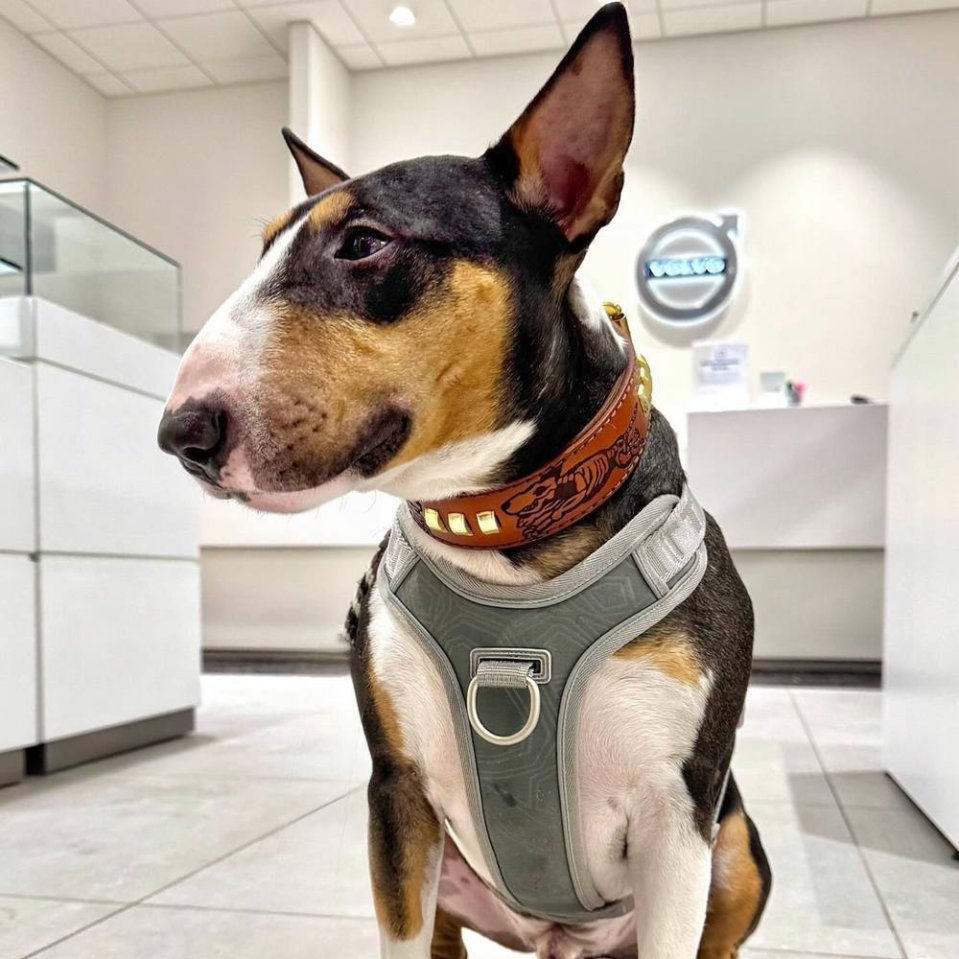
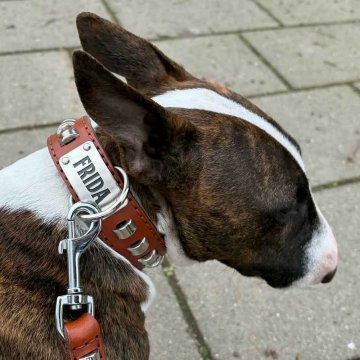
The best collar for an English Bull Terrier is usually a wide leather collar or a properly fitted half check collar designed to match the breed's unique anatomy. English Bull Terriers have powerful necks, distinctive head shape and surprising pulling strength. Because of that, collar width, stability and construction matter far more than decorative details.
If you are unsure whether a classic buckle collar or a half check collar is the better option, start by looking at how your Bull Terrier behaves on the lead. The dog's behaviour often determines the right choice more accurately than age, sex or weight.
What is the best collar for an English Bull Terrier?
The best collar for an English Bull Terrier is one that works with the breed's anatomy rather than against it. It should distribute pressure evenly, remain stable on the neck during movement and provide reliable control when the dog suddenly changes direction or throws its weight into the lead.
Many owners assume that strength is the main challenge. In reality, the bigger issue is the combination of a muscular neck, a unique head shape and the way Bull Terriers use their entire body when pulling.
This is why experienced Bull Terrier owners often prefer wide leather collars and properly fitted half check collars over narrow, lightweight designs.
Why is choosing a collar for an English Bull Terrier different?
The English Bull Terrier is one of the most distinctive breeds in the dog world. Its anatomy creates challenges that many generic collars simply were not designed to handle.
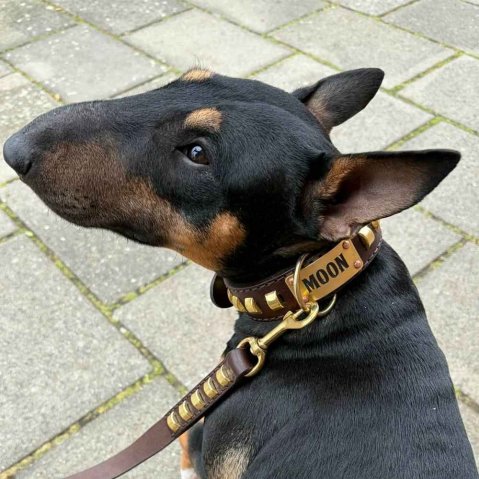
The first thing that makes Bull Terriers different is their famous egg-shaped head. Unlike many breeds, they have very little stop between the forehead and muzzle. The profile forms a smooth curve rather than a clearly defined transition.
At the same time, the difference between head width and neck circumference is often smaller than in many other breeds.
This detail may seem insignificant until you attach a lead.
In practice, it means a Bull Terrier can sometimes back out of a poorly fitted collar far more easily than a Labrador, German Shepherd or Golden Retriever.
Why can some Bull Terriers escape from collars?
The answer is simple: biomechanics.
When most dogs pull backwards, the wider skull prevents the collar from slipping over the head. In Bull Terriers, that margin is often smaller.
If the collar is too loose, too narrow or poorly fitted, it may slide forward surprisingly easily during a sudden backward movement.
Many owners first discover this when their dog becomes startled, reacts to another dog or suddenly decides that walking backwards is a good idea.
That is one reason why many Bull Terrier owners eventually move towards properly fitted half check collars.
The Bull Terrier neck: shorter than it looks, stronger than most expect
The second major factor is the neck itself.
The English Bull Terrier was developed as a powerful, athletic and determined breed. The neck is heavily muscled and capable of transferring an impressive amount of force.
This becomes obvious the moment a Bull Terrier decides to investigate something interesting.
A squirrel appears.
A cat crosses the road.
Another dog walks by.
Within a second the entire front assembly of the dog comes into play.
The neck, shoulders and chest work together as one powerful structure.
That force is transferred directly into the collar.
How does a Bull Terrier actually pull?
This is where many generic collar guides completely miss the point.
Bull Terriers rarely pull using only their neck.
Most of them lean into the lead with their entire front end. The chest drives forward, the shoulders engage and the neck becomes a stabilising force.
That is why collar construction matters so much.
A real-world example is easy to imagine.
Your dog spots another dog across the street.
He launches forward.
The collar rotates ninety degrees.
The buckle ends up under the neck.
Pressure concentrates into a narrow line.
Within five seconds you know whether the collar truly fits the breed.
This is often called the five-second test. A suitable collar remains stable. An unsuitable collar immediately reveals its weaknesses.
What looks good in photos versus what works in real life?
This is where many owners learn an expensive lesson.
A narrow decorative collar may look fantastic in a product photograph. It may even feel fine while the dog is standing still.
Real life is different.
The moment the dog throws its weight into the lead, the collar begins to rotate. Pressure concentrates in one area. Control becomes less predictable.
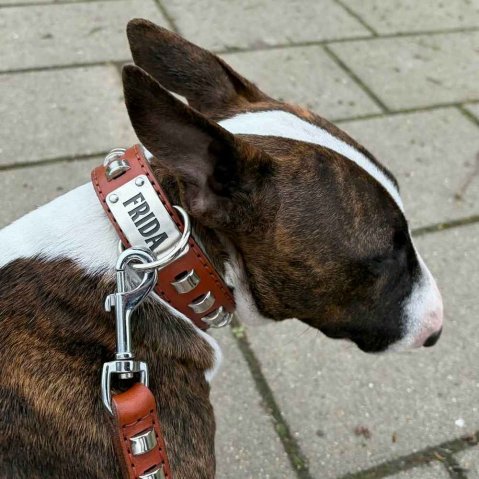
A wider collar may appear more substantial, but it often distributes force much more effectively and remains centred on the neck.
What looks elegant indoors is not always what works outdoors.
Bull Terriers have a talent for exposing that difference very quickly.
When is a classic collar the best choice?
A classic buckle collar is usually the best option for the majority of adult English Bull Terriers.
If your dog walks reasonably well on lead, spends a lot of time wearing a collar and has no tendency to back out of it, a traditional design is often the most practical solution.
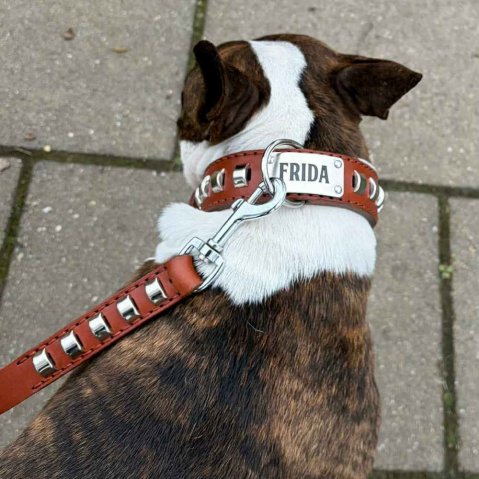
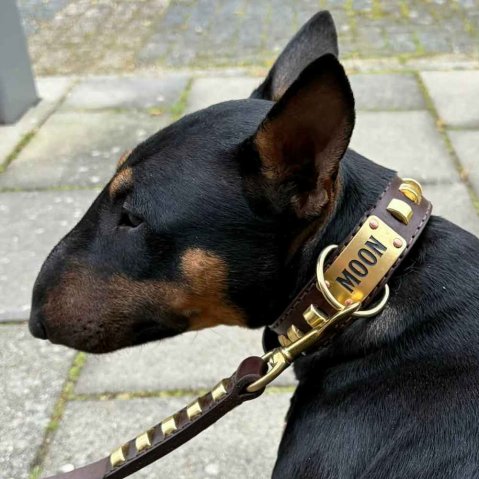
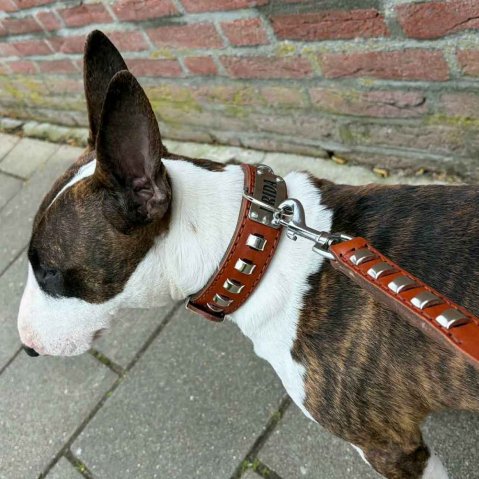
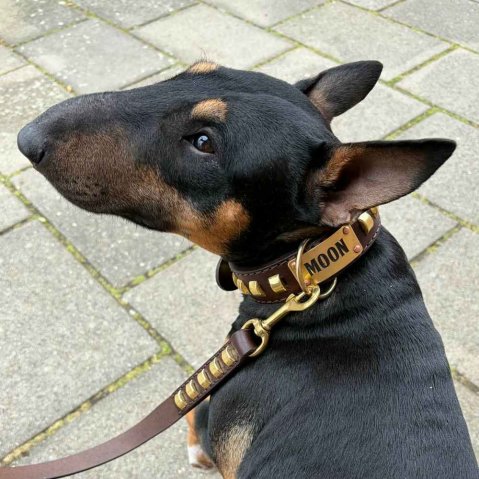
The Viking Collar is particularly well suited to the powerful neck structure of the breed.
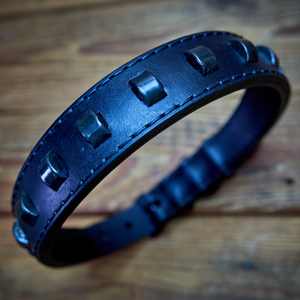
Its broader design helps distribute pressure more evenly during everyday walks.
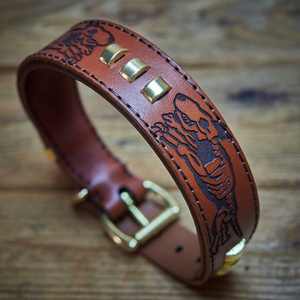
Owners looking for a cleaner, everyday style often choose the Frenchie Flair Collar.
When does a wider collar make sense?
Dogs with exceptionally muscular necks often benefit from a larger contact area.
That is where the Beefy Bang Bang Collar comes into its own.
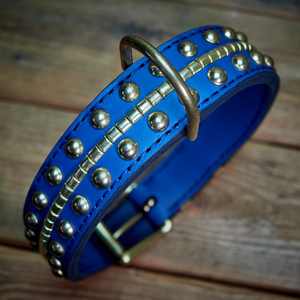
The wider leather spreads force across a larger section of the neck, which many owners notice immediately during stronger pulling episodes.
When should you choose a half check collar?
Half check collars are not only for dogs that pull.
Their biggest advantage is often security.
If your Bull Terrier occasionally backs away from pressure, tries to reverse out of collars or frequently changes direction, a half check design may provide greater confidence.
The Dapper Half Check Collar is a popular solution for owners looking for extra security without sacrificing everyday comfort.
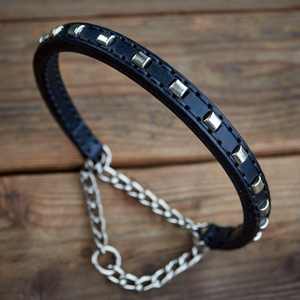
For particularly strong adult dogs, many owners prefer the Rattlesnake Half Check Collar.
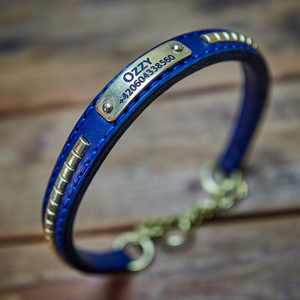
Harness or collar for an English Bull Terrier?
This question appears in search engines every day.
For most everyday situations, experienced Bull Terrier owners still prefer collars.
A collar often allows more precise communication through the lead and works naturally with the dog's movement.
A harness can be useful for specific activities or medical situations, but for many determined Bull Terriers it may also allow them to generate even more pulling power.
Decision guide
- Calm everyday walker: Frenchie Flair or Viking.
- Very muscular neck: Beefy Bang Bang.
- Dog backs out of collars: Dapper Half Check.
- Strong puller: Rattlesnake Half Check.
- Still unsure: focus on width and fit before decorative details.
Do not forget the lead
Even the best collar is only half of the system.
For everyday use, the Dapper Lead provides an excellent match.
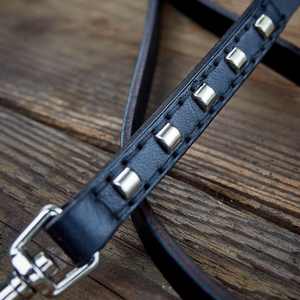
Owners seeking a heavier-duty option often choose the Goliash Lead.
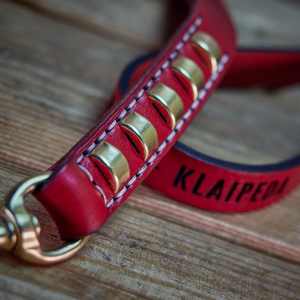
Common mistakes
- Choosing a collar based only on appearance.
- Using a collar that is too narrow for a powerful neck.
- Leaving excessive slack.
- Underestimating the strength of an adult Bull Terrier.
- Using lightweight hardware on a strong pulling dog.
Professional perspective
After years of making collars for Bull Terriers, one pattern repeats itself constantly.
Owners initially focus on colour, decoration and appearance. Months later, they start talking about stability, pressure distribution and how the collar behaves during real walks.
That is not a coincidence.
The English Bull Terrier quickly reveals the difference between equipment that looks good and equipment that actually works.
A truly good collar is the one you stop thinking about during the walk because it simply does its job.
Who is this advice for?
- English Bull Terrier owners.
- Owners of strong pullers.
- Dogs with powerful necks.
- Dogs prone to backing out of collars.
- Owners looking for long-term leather equipment.
Final summary
The right collar for an English Bull Terrier starts with anatomy, not decoration.
Width, stability and construction have a greater impact on daily use than most owners initially expect.
For many Bull Terriers, a quality wide leather collar is the ideal solution. For dogs prone to escaping or pulling heavily, a properly fitted half check collar may offer greater security.
An English Bull Terrier may not be the biggest dog in the park, but when it decides to test your equipment, you discover very quickly whether you bought a decoration or a tool.
Featured Dogs