Classic Collar vs Half-Check Collar: Which One Does Your Dog Need?
Short answer: Choose a classic collar for fixed, predictable everyday comfort and a dog that does not try to back out. Choose a correctly fitted half-check when the dog needs clearer contact under tension or better protection against slipping free. Neither type teaches loose-lead walking by itself; equipment manages the connection, while training changes behaviour.
One second, your dog is reading yesterday’s news on a lamp post. The next, a pigeon takes off, the lead snaps tight and the peaceful walk develops an engine. That is when the difference between a classic collar and a half-check stops being theory.
Both can be comfortable. Both can handle a strong dog. Both can also be completely wrong when chosen by appearance alone. A collar should not merely look convincing while the dog poses. It must keep its shape and do its job when the dog puts real weight into the lead.
Classic collar vs half-check: the construction difference
How does a classic collar work?
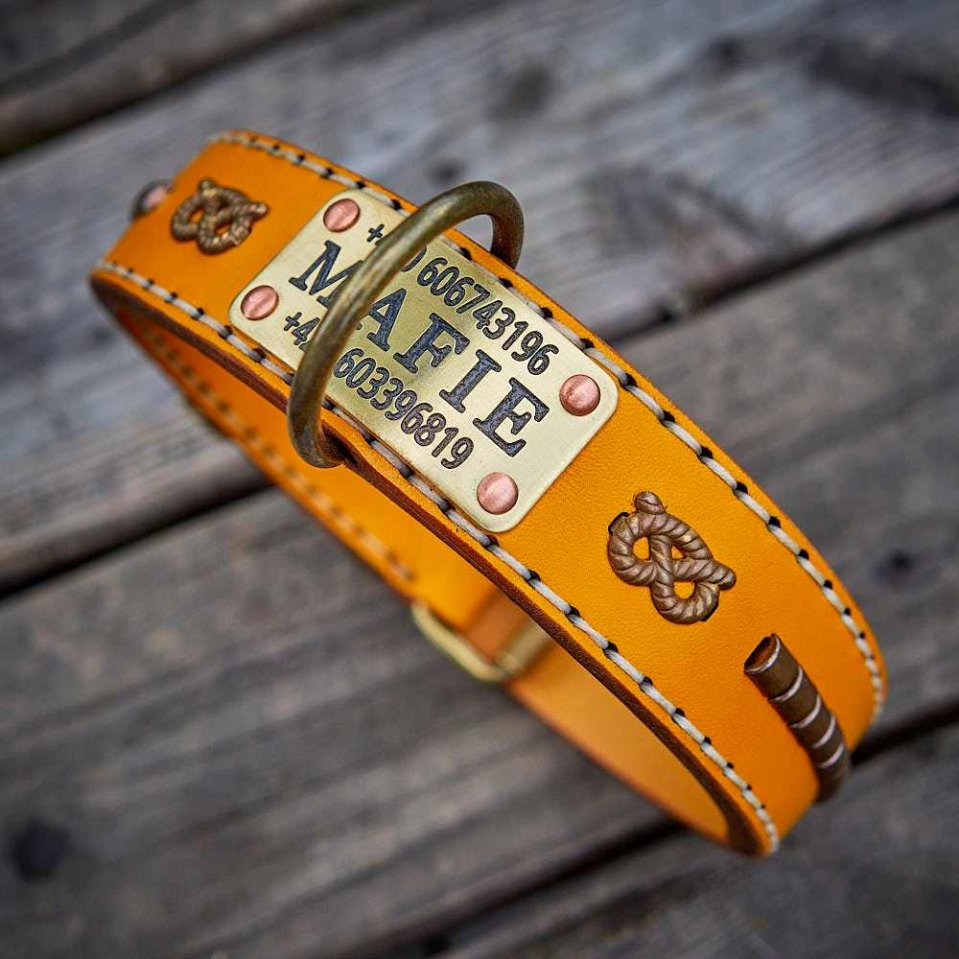
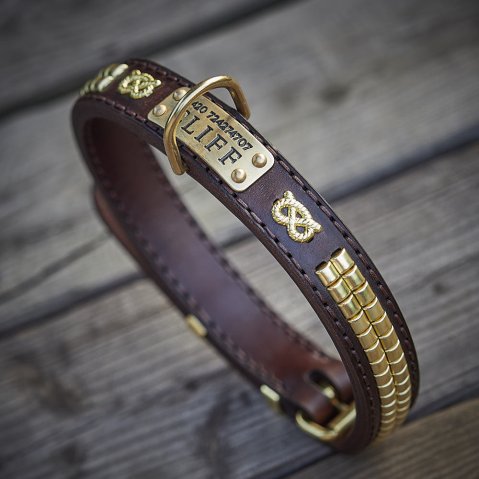
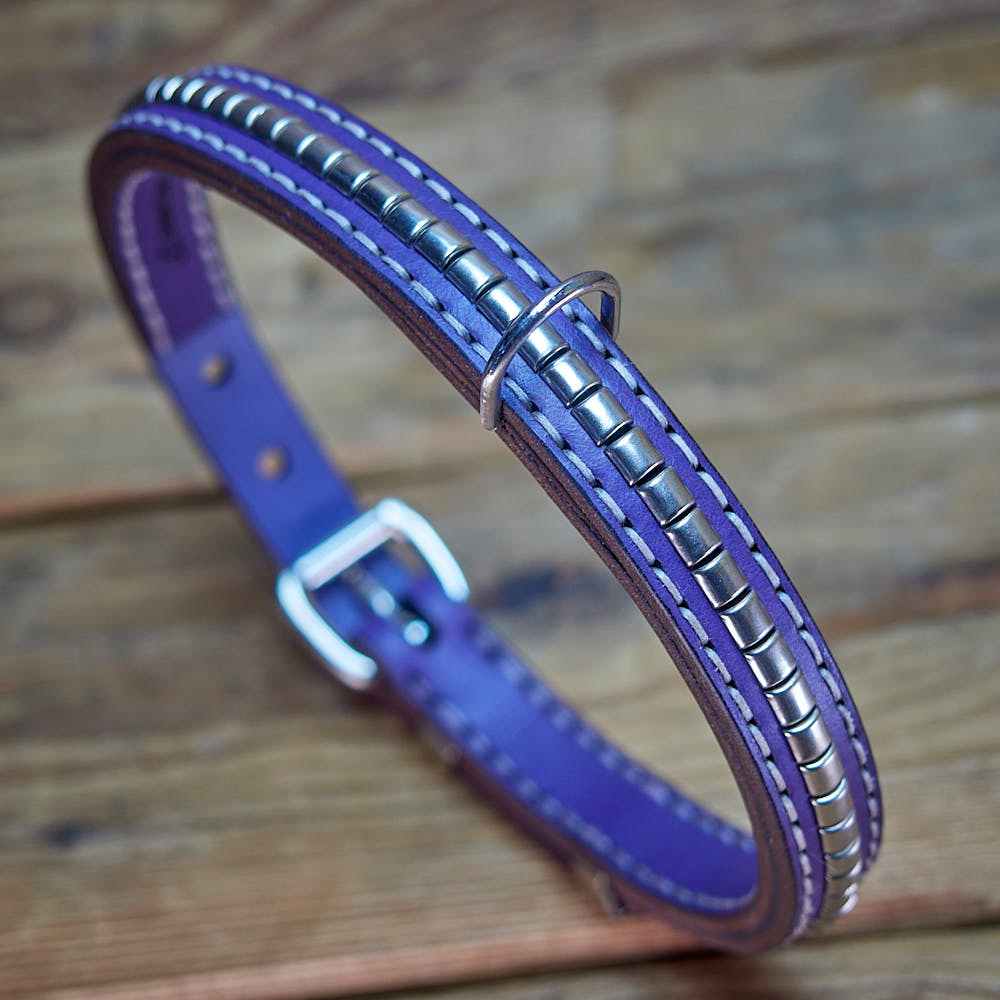
A classic collar has a buckle and keeps the same circumference whether the lead is loose or tight.
Once fastened, nothing slides or shortens. The dog gets the same amount of room while standing, sniffing, walking or leaning forward. This makes the feel predictable and the fit easy to check.
Slade Czech classic collars normally use five holes spaced 2 cm apart. The supplied neck measurement is intended to land on the middle hole. You therefore have two holes in either direction for minor changes without starting the whole measuring circus again.
How does a half-check collar work?
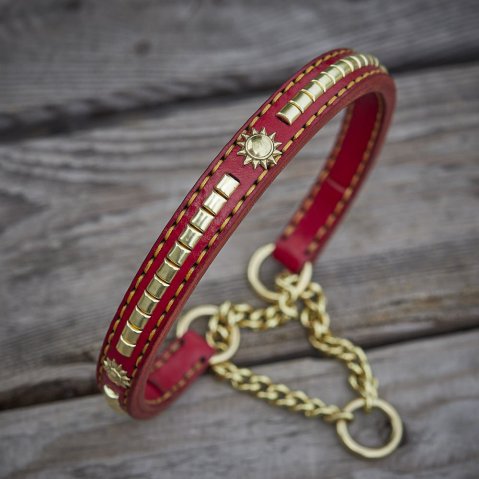
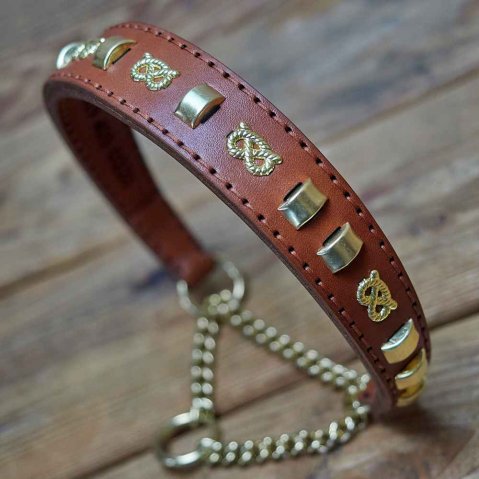
A half-check forms a closed loop that rests loosely on a slack lead and becomes smaller within a defined range under tension.
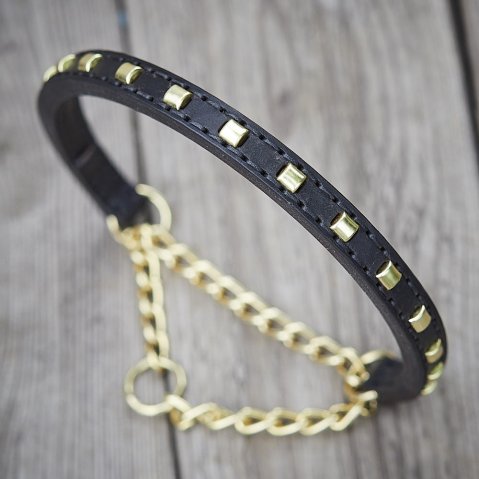
The collar goes over the dog’s head rather than opening with a buckle. When the dog walks calmly, it lies more freely around the neck. When the dog pulls, lunges or backs away, the control section shortens the loop. Once tension disappears, the collar releases again.
A properly fitted half-check is not an unrestricted choke collar. It has a relaxed position and a limited working position. The point is controlled movement and a cleaner signal—not seeing how much neck can disappear into leather.
Which dogs suit a classic collar?
A classic collar is usually the best everyday choice for a dog that walks reliably, tolerates a buckle and does not reverse out of its collar.
It goes on quickly, stays at one size and does not need to pass over the ears. That is useful for dogs that dislike equipment moving close to their eyes or for owners who put the collar on and take it off several times a day.
It is also practical for puppies. Their neck size changes quickly, and several adjustment holes provide useful room. Check the fit often, though. Puppies have a special talent for growing immediately after you have finally ordered something that fits.
A classic collar can work very well for a powerful dog too. “Strong dog” does not automatically mean “half-check”. If the dog is secure in a fixed collar and you prefer constant contact, the real questions are width, leather structure and hardware.
Two classic collars, two different jobs
Django: everyday classic without the soft-belt behaviour
Django suits owners who want a fixed collar with a wide choice of widths and a construction that stays readable during ordinary walks.
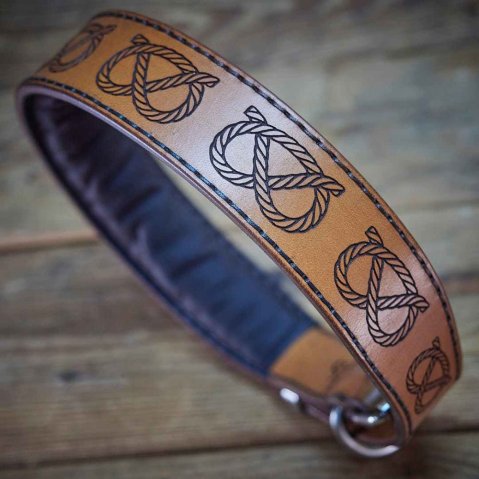
The Django Classic Collar can be ordered from 13 to 50 mm wide. That makes it possible to match the same basic buckle construction to a smaller dog, a medium companion or a bull-type dog with a neck that looks as though it has its own gym membership.
Django solves stability and everyday fit. It does not prevent a badly fitted collar from slipping over the head, and it does not teach the dog to stop pulling. What it gives you is a fixed leather collar, metal hardware and a width selected for the dog in front of you—not for an imaginary average dog.
King’s Colours Classic: wider support for a powerful neck
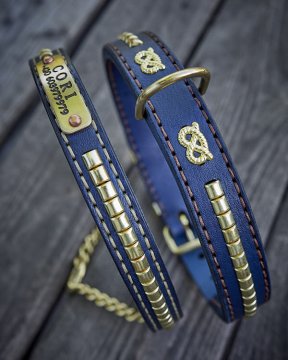
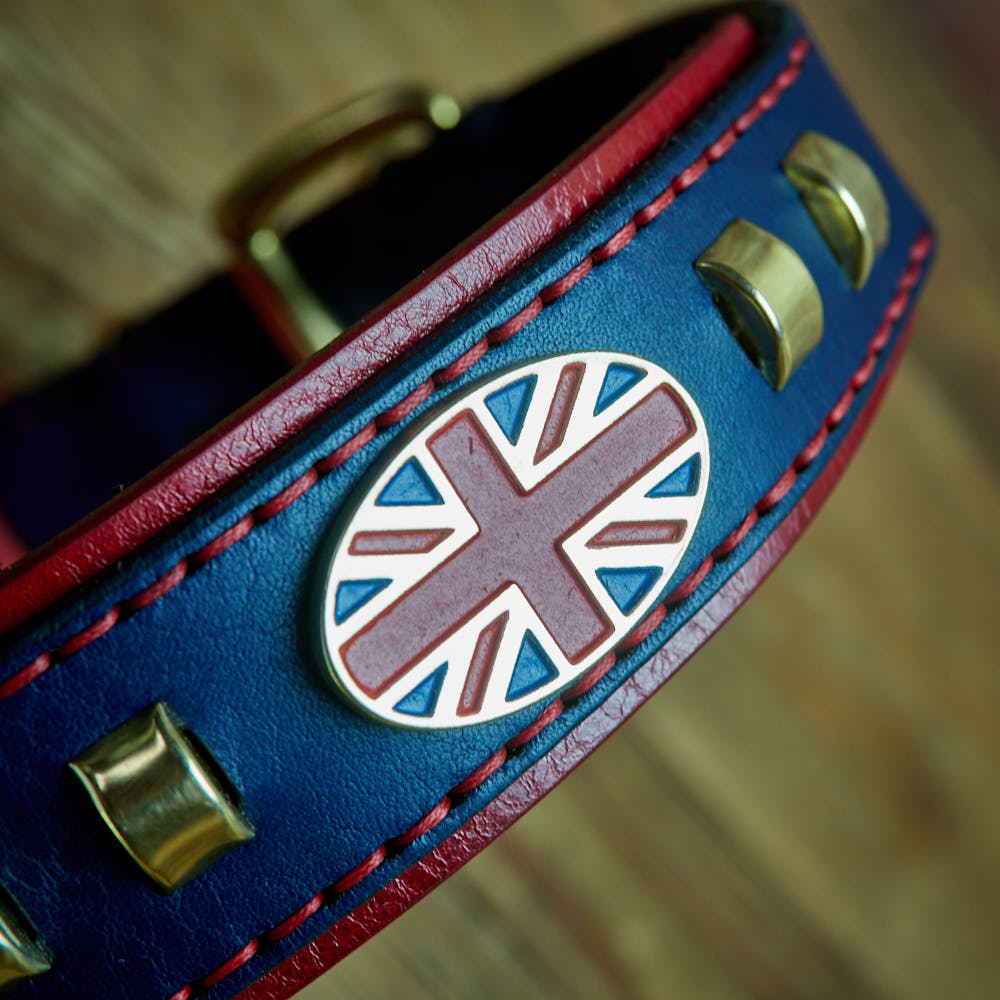
King’s Colours Classic makes sense when you want a fixed buckle collar with a substantial 40 mm double-layer construction.
The King’s Colours Classic Collar is built at 40 mm wide. The larger contact area helps the collar sit more steadily and spread load better when a stocky dog leans into the lead.
This is the classic-collar answer for an owner who wants everyday comfort without putting a narrow strap on a strong neck. The Union Jack catches the eye, but the useful bit is underneath: firm leather, hand stitching and solid hardware. Looks good standing still. Still has a job when the dog sees a cat.
It will not tighten when the dog backs away. If escape prevention is the main concern, a half-check or a secure backup system may be more appropriate.
Which dogs suit a half-check collar?
A half-check is useful for dogs that can reverse out of a fixed collar, have a head close in width to the neck or need a clearer change in contact when the lead tightens.
Picture the dog hearing a metal trolley behind it. The head drops, the ears fold and the whole body moves backwards. A loose classic collar can travel towards the ears and, if the opening is large enough, pass over the head.
A correctly measured half-check reduces its circumference when the lead comes under tension. This makes backing out more difficult and gives the handler a faster response when a compact dog goes from calm to missile in one blink.
The collar still needs correct sizing. Too large, and it may remain big enough to pass over the head even in its working position. Too small, and it never reaches a comfortable relaxed position.
Craze: loose in calm, awake when the dog launches
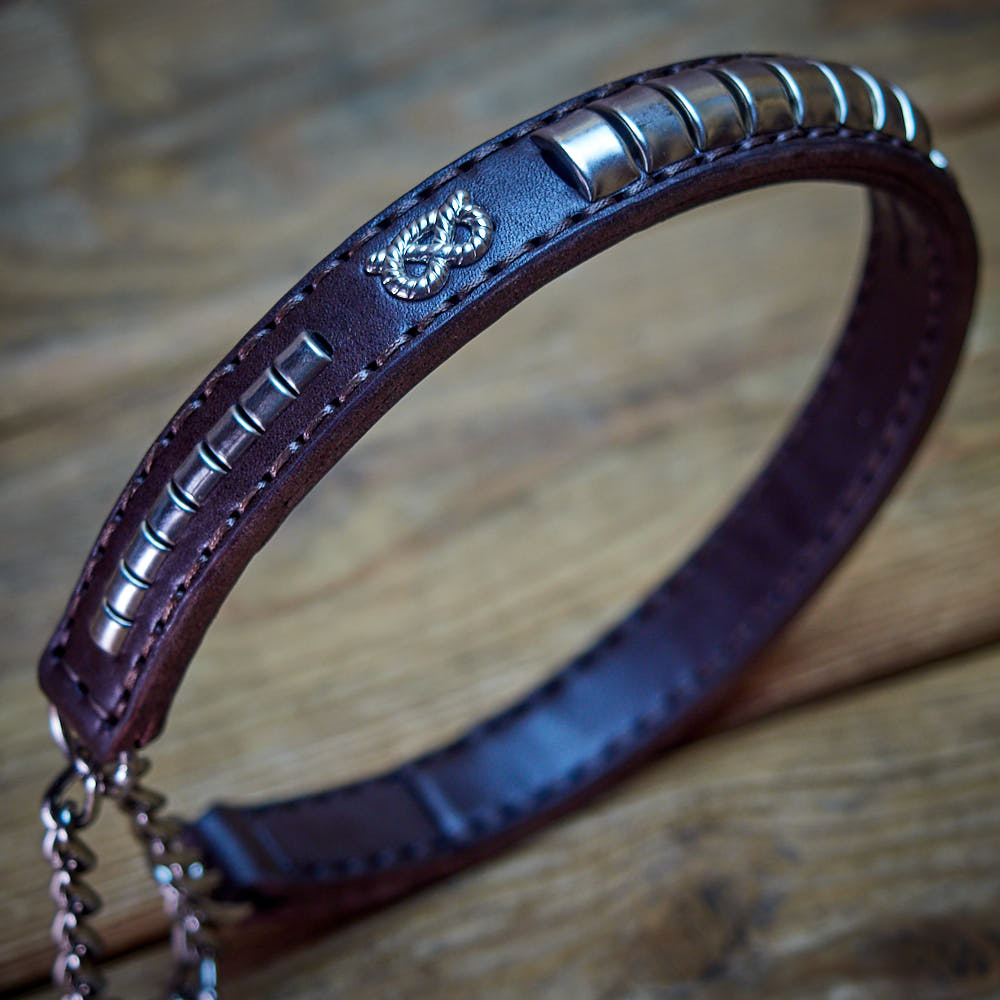
Craze is the practical choice when you want a leather half-check that responds during pulling and releases again when the lead relaxes.
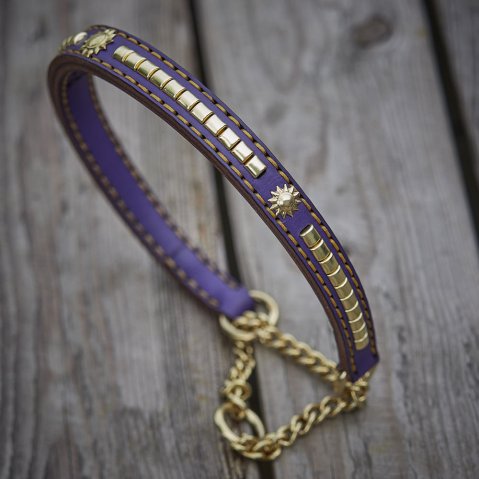
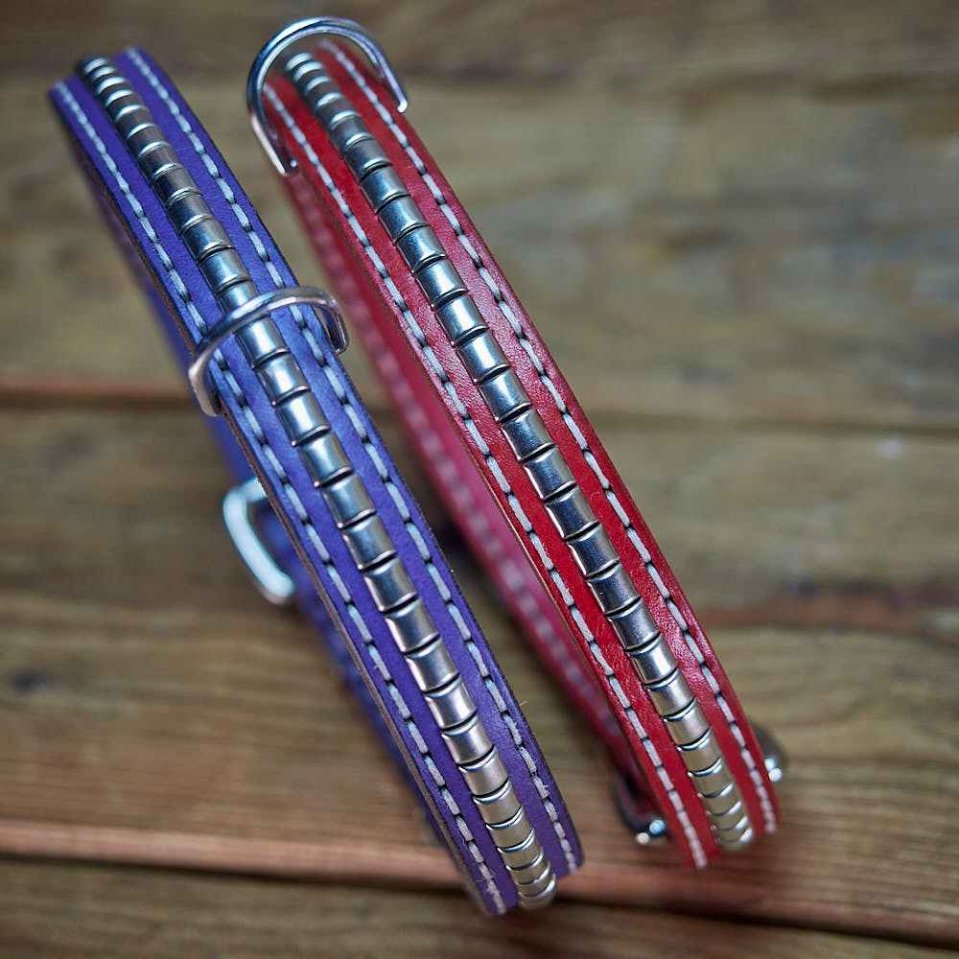
The Craze Half-Check Collar is made according to the dog’s head circumference. Its moving construction reacts during a sudden pull instead of maintaining constant pressure around the neck.
Craze helps with contact, stability and escape security. It does not cure pulling, fear or overexcitement. If the dog spends the entire walk dragging you from tree to tree, the training plan still has work to do. Leather is talented. It is not a behaviourist.
Control versus everyday comfort
The classic collar prioritises consistency; the half-check adds a limited mechanical response when tension appears.
A classic collar can be the calmer choice for all-day routine because it stays in one position. A half-check may rest more loosely during a relaxed walk, but the moving section makes it less suitable for unattended wear.
Remove a half-check before crating, rough play or leaving the dog alone. Loops and moving hardware can catch on bars, branches, furniture or another dog. Walk equipment belongs on walks. It does not need a night shift.
For constant heavy pulling, neither collar is a complete answer. Create distance from triggers, reward slack in the lead and train in short sessions where the dog can still think. Five good minutes beat half an hour with a crocodile on the other end.
Which collar is safer against slipping out?
A correctly fitted half-check usually provides better protection against reversing out, but no collar compensates for poor measurement.
Watch what happens when the dog lowers its head and applies gentle backward pressure. Warning signs include:
- the classic collar travels over the base of the ears;
- both ears can enter the opening while the dog backs away;
- the half-check reaches the end of its movement before becoming secure;
- the collar rotates sharply or hangs far below the intended position.
For a frightened dog with a serious flight risk, connect the lead to a suitable harness through a secure backup strap. Management keeps the dog attached today. Training works on why the dog wants to escape tomorrow.
How to measure a classic collar
Measure the dog’s neck in the position where the finished collar will sit.
- Stand the dog naturally and use a soft tailor’s tape.
- Measure around the middle of the neck.
- Keep the tape comfortably close without compressing the throat.
- Record the actual measurement requested; do not add several centimetres “for comfort”.
- For Slade Czech classic collars, the measurement corresponds to the middle of five holes spaced 2 cm apart.
Do not measure an old collar laid flat unless specifically instructed. Different buckle designs produce different results. Measure the dog, not the archaeological find from the kitchen drawer.
How to measure a half-check
Measure around the widest part of the head and over the ears because the closed collar must pass over them.
- Keep the dog standing with the head in a natural position.
- Pass a soft tape around the forehead and over the ears.
- Follow the exact route the collar will take when being put on.
- Keep the tape close without crushing the ears or coat.
- Submit the head circumference, not the neck circumference.
This is the expensive little mistake: the neck measures 42 cm, the head measures 48 cm, and somebody orders 42 cm because “it is a collar”. It is also a closed loop. The ears will not negotiate.
See the detailed guide to measuring classic and half-check collars correctly.
What width should you choose?
Choose width according to the dog’s size, neck length, strength and use—not according to which option fills the photograph best.
- Small, light dog: usually 13–19 mm, depending on anatomy and use.
- Medium dog: often 19–32 mm for a balance of stability and free movement.
- Strong, compact dog: commonly 32–50 mm when more support and pressure distribution are needed.
- Short neck: avoid a width that hits the jaw or shoulders.
- Long neck: a wider collar may sit more calmly, provided it does not restrict movement.
These are practical starting points, not laws carved into leather. If the collar folds, rolls or digs into one line, it may be too narrow or too soft. If it blocks head movement, it is too wide.
Read more about matching collar width to the dog’s build and strength.
Quick decision: if A, choose X
- Calm dog, no escape attempts: classic collar.
- Growing puppy: adjustable classic collar with frequent fit checks.
- Dog dislikes equipment over the head: classic buckle collar.
- Powerful dog, fixed fit preferred: wider classic collar such as King’s Colours.
- Different widths needed for different builds: Django Classic.
- Dog backs out or needs clearer response under tension: correctly measured half-check such as Craze.
- Dog panics or bolts: half-check or suitable fixed collar plus a secure harness backup and professional help.
Frequently asked questions
Is a half-check the same as a choke collar?
No. A correctly fitted half-check has a limited tightening range and a relaxed position.
Will a half-check stop my dog pulling?
No. It may improve handling and lead contact, but training must change the pulling behaviour.
Which collar is better for a puppy?
An adjustable classic collar is usually more practical while the puppy grows.
Can a dog wear a half-check all day?
Use it for supervised walks and remove it for crating, rough play and unattended wear.
Which measurement does a classic collar need?
Measure the actual neck circumference where the collar will sit.
Which measurement does a half-check need?
Measure the widest circumference of the head over the ears.
Which collar is harder to back out of?
A correctly fitted half-check is generally more secure, but high-risk dogs also need a secure backup attachment.
Choose by function, then add the swagger
For fixed everyday comfort, explore all classic leather dog collars. If your dog needs a limited tightening action or better protection against reversing out, compare our handmade half-check collars.
A good collar should look right. More importantly, it should stay calm when the dog decides the pavement needs drama.
Featured Dogs