Staffy vs Amstaff Collar: Do They Really Need the Same Collar?
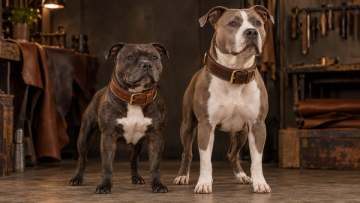
Short answer: A Staffordshire Bull Terrier and an American Staffordshire Terrier can wear the same type of collar, but they should not receive the same collar by default. Choose according to the individual dog’s neck circumference, head-to-neck proportions, weight, pulling style and intended use. Breed alone cannot tell you the correct width, fit or construction.
A compact Staffy spots a pigeon and launches. A taller Amstaff leans towards another dog and turns the lead into a wire. Both are bull breeds. Both can be powerful. Yet the load reaching the collar—and the way the collar sits on the neck—may be quite different.
Same bull family. Different dog. So why automatically choose the same collar?
The five-second difference
A Staffy is generally shorter, more compact and lighter; an Amstaff is usually taller, longer in outline and heavier. That does not make every Amstaff stronger or every Staffy easier to handle. A determined 15-kilogram Staffy can hit the end of a lead with remarkable enthusiasm, while a well-trained 28-kilogram Amstaff may walk beside you without putting the hardware to work.
The collar must therefore fit the dog in front of you—not the breed name printed on a registration document.
For the wider breed picture, read our comparison of the real differences between the Staffy and Amstaff. Here we will concentrate only on the differences that matter around the neck.
Which anatomical differences affect collar choice?
Body size changes the load, but not the whole answer
An Amstaff usually brings more total body mass into a lunge, while a Staffy often delivers force from a shorter, compact frame.
The Staffordshire Bull Terrier breed standard describes an ideal height of roughly 35.5–40.5 cm, with weight in proportion to sex. The Amstaff is generally taller, with preferred heights around 46–48 cm for males and 43–46 cm for females. The standards describe typical proportions, not a shopping chart for collars.
Weight matters when a dog accelerates, hits the end of the lead or plants all four feet because the walk is apparently over by democratic decision. But handling also depends on speed, technique and training. A smaller Staffy can produce a sharp impact. A heavier Amstaff may create a slower but sustained pull.
Neck length and shape decide how much width fits
Choose the widest collar that remains clear of the jaw and shoulders and allows natural head movement.
Many Staffies have a short, muscular neck with limited space between the jaw and shoulder. A collar that looks magnificent on the table can be too wide once the dog lowers its head to sniff. Warning signs include the upper edge pressing into the jaw, the lower edge touching the shoulders, restricted head turning or the entire collar rocking instead of lying flat.
An Amstaff often has a little more neck length, but individual variation is considerable. A lean female and a broad adult male should not be ordered the same collar because the website photograph looked heroic.
Width helps distribute pressure over a larger area. It does not justify covering half the dog’s neck in leather. For a deeper explanation, see how to choose the correct dog-collar width.
Head-to-neck proportions affect escape security
If the head is not much wider than the neck, check whether the dog can reverse out of a fixed collar.
Observe the dog when it lowers its head and moves backwards. Do the ears begin to pass through the collar? Does the collar slide rapidly towards the skull? Does panic make the dog narrow its head, fold its ears and reverse with full force?
This matters more than whether the dog is a Staffy or an Amstaff. A correctly fitted classic collar may be secure on one dog and unsuitable for its littermate. For a dog that genuinely backs out, a measured half-check or a collar-and-harness backup may be the safer system.
Measure the dog, not the breed
Measure where the finished collar will sit and use the measurement requested for that particular construction.
- Stand the dog naturally rather than measuring while it is curled on the sofa.
- Place a soft tape around the middle of the neck.
- Keep it comfortably close without compressing the throat or leaving a floating loop.
- Check that the intended width fits between jaw and shoulder.
- Repeat the measurement after movement if the dog has loose skin or an unusually muscular neck.
For a classic Slade Czech collar, provide the actual neck circumference as instructed on the product page. The finished collar is designed so that this measurement corresponds to the middle adjustment hole. Do not add several centimetres for comfort. Comfort already belongs in the measuring method; invented extra room belongs in the escape plan.
A closed half-check requires a different measurement because it must pass over the widest part of the head and ears. The neck measurement alone is not enough. Compare both constructions in our guide to classic and half-check collars.
Classic or half-check for a Staffy and Amstaff?
Choose a classic collar for fixed everyday fit
A classic buckle collar suits a dog that does not reverse out and whose owner wants predictable, unchanging circumference.
It is practical for daily walks, quick fitting and growing youngsters because several holes allow adjustment. It also suits dogs that dislike equipment passing over the eyes and ears.
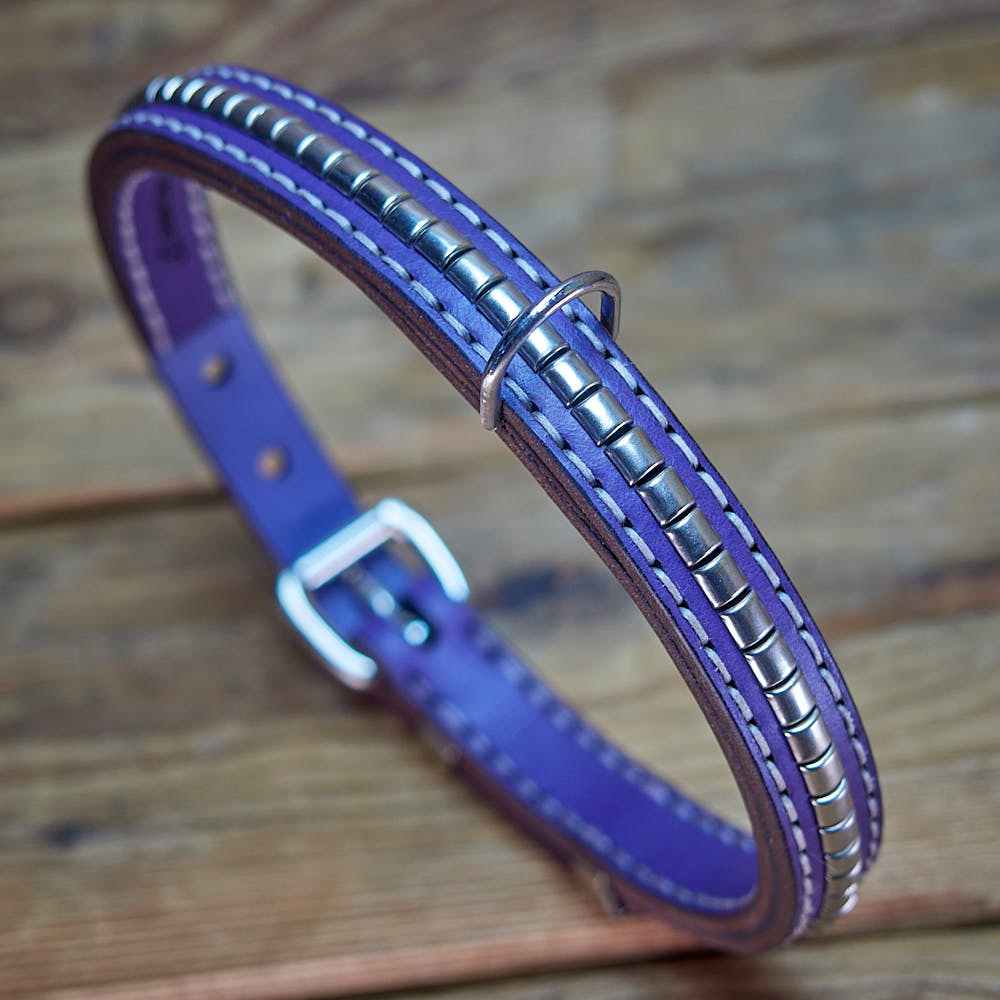
The Django Classic Collar is an everyday option available in several widths, allowing the construction to be matched to the individual Staffy or Amstaff. It solves fixed fit, stability and everyday connection. It does not stop pulling and cannot rescue careless measurement.
Choose a half-check when controlled movement has a purpose
A correctly fitted half-check can offer clearer contact under tension and better protection against reversing out.
It should rest more freely on a slack lead and reduce its circumference only through a limited working range. It is not an unrestricted choke collar and should not be used to punish the dog with repeated jerks.
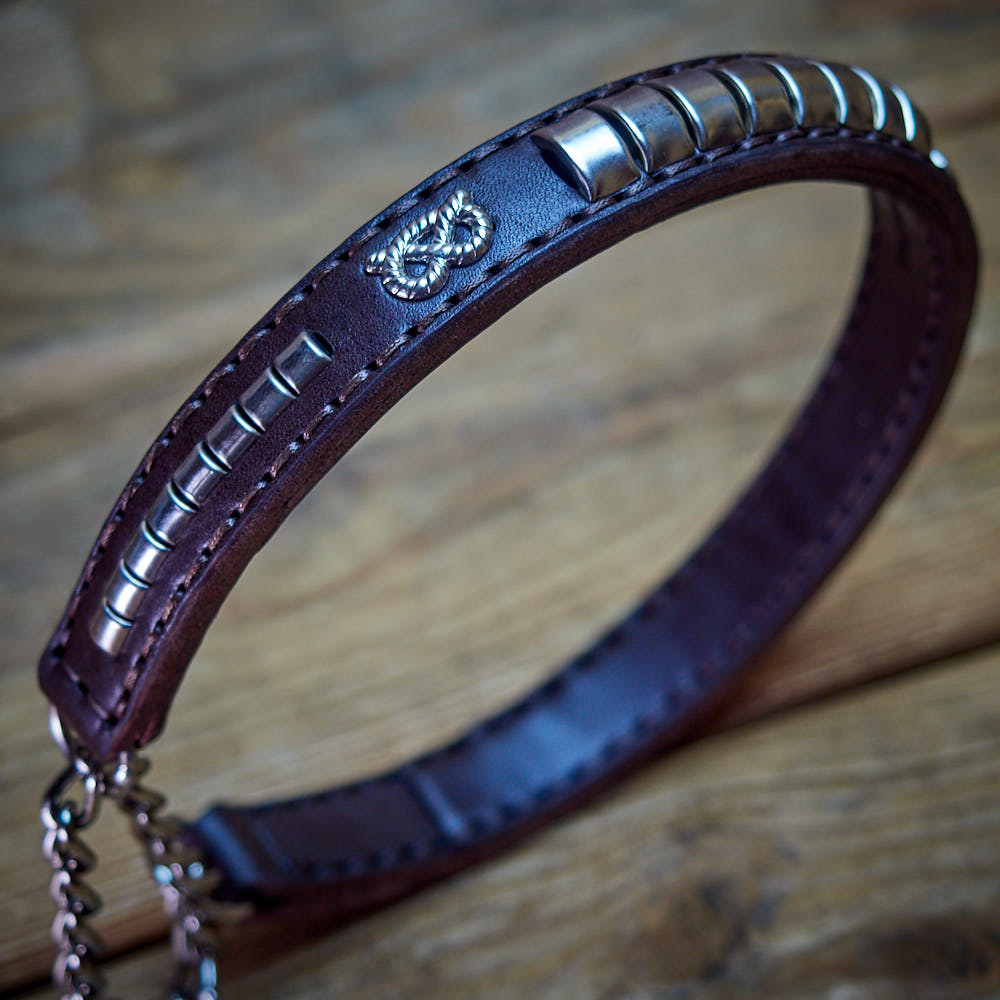
The Craze Half-Check Collar makes sense for a dog whose proportions or behaviour require that limited response. It can improve security and handling. It cannot cure fear, overexcitement or pulling. Leather is useful; it has not yet qualified as a behaviourist.
How wide should the collar be?
Do not select width from the breed name alone; match it to neck length, circumference, strength and use.
- A lighter youngster may need less width and weight while growing.
- A compact adult Staffy often benefits from stable pressure distribution, but the collar must not crowd a short neck.
- A larger Amstaff may comfortably carry a wider collar, provided it does not restrict the jaw or shoulders.
- A dog that walks calmly does not need maximum bulk merely to prove membership of the bull family.
- A strong puller needs suitable construction and training—not decorative armour.
Watch the collar during a turn, a sniff and a sudden look upwards. It should remain flat rather than folding into a narrow ridge. If it rolls, twists or digs into one line, the construction may be too narrow or too soft. If it pushes the head upwards, the width is excessive.
When a substantial wide collar makes sense
A wide double-layer collar is useful when a broad, powerful neck needs greater stability and load distribution.
The King’s Colours Classic Collar uses a substantial 40 mm double-layer construction. It suits an adult Staffy or Amstaff with enough neck length and body substance to carry that width comfortably. It offers a fixed buckle fit and a broad contact area for real daily use.
It will not tighten if the dog backs away, and it will not teach loose-lead walking. What it does is remain a proper collar when the dog sees a cat and suddenly remembers a very urgent appointment across the road.
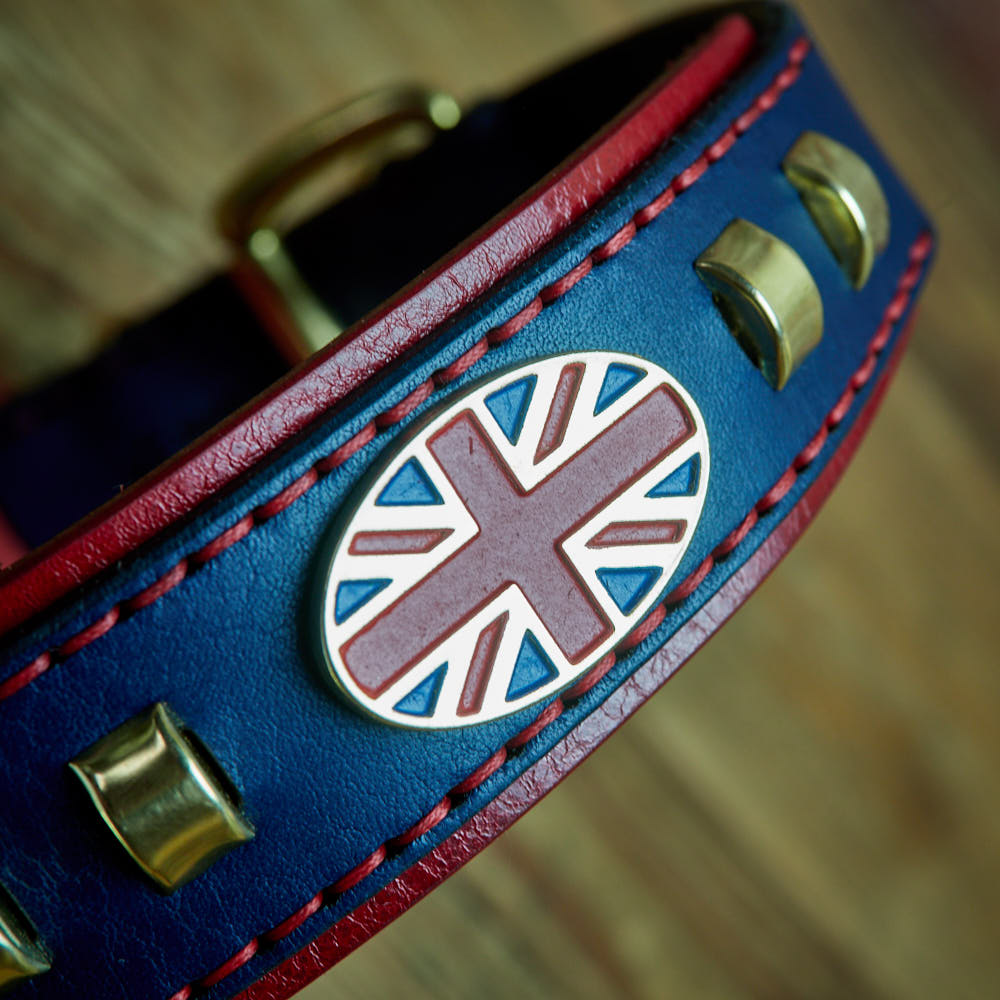
Leather, stitching and hardware: what actually carries the load?
The whole load path matters: leather, stitching, buckle, D-ring and the material surrounding every fitting.
A thick-looking collar can still be weak if the leather is soft around the holes, the thread is exposed to abrasion or the D-ring is attached through a poorly supported section. Shiny hardware proves only that somebody owned a polishing cloth.
Inspect whether the collar keeps its shape when bent by hand, whether the buckle tongue sits cleanly in the hole and whether stitching remains even around load-bearing points. After rain, let leather dry naturally away from direct heat. Check regularly for torn holes, loose fittings, cracked leather and damaged thread.
Looks good in a photograph is not the same as works when the lead snaps tight. We have made leather equipment by hand since 2004, and the awkward moments—lunges, sudden stops and dogs putting their whole body behind a decision—are exactly where construction stops being marketing and starts doing its job.
Quick decision: if A, choose X
- Calm dog, secure in a fixed collar: choose a correctly measured classic collar.
- Growing Staffy or Amstaff puppy: choose an adjustable classic collar and check the fit frequently.
- Dog reverses out: consider a correctly measured half-check or a secure harness backup.
- Short neck: avoid excessive width, even if the dog is powerful.
- Longer, broad neck with strong pulling: consider a stable wider double-layer construction.
- Constant pulling: manage distance from triggers and train loose-lead walking; do not expect the collar to teach it.
- Coughing, pain or respiratory concerns: stop applying neck pressure and consult a veterinarian.
Common mistakes
Buying “an Amstaff size” or “a Staffy size”
There is no single safe collar size for either breed. Age, sex, breeding line, conditioning and individual anatomy produce large differences. Measure the actual dog.
Choosing the widest collar available
More leather is not automatically more comfortable. Excessive width can hit the jaw, shoulder or throat and restrict movement.
Adding room twice
Do not measure loosely and then add extra centimetres again. The result may rotate, catch a lower jaw during play or slip over the head.
Expecting equipment to stop pulling
A collar manages the physical connection; training changes the behaviour. Reward slack, practise before the dog reaches full arousal and create distance from triggers. Five useful minutes beat half an hour with a compact crocodile on the lead.
When professional help is the right move
Consult a qualified reward-based trainer or behaviour professional if the dog lunges aggressively, panics, redirects onto the lead or handler, or repeatedly escapes equipment. Sudden resistance to wearing a collar, coughing, gagging, voice changes, sensitivity around the neck or reduced head movement should be discussed with a veterinarian.
For a serious flight risk, use a properly fitted harness and secure backup connection while the underlying fear is addressed. Management keeps the dog attached today. Training changes what happens tomorrow.
Frequently asked questions
Does an Amstaff always need a wider collar than a Staffy?
No. Amstaffs are generally larger, but width must suit the individual neck length, circumference, strength and use.
Is a 40 mm collar suitable for every adult Staffy?
No. It may suit many broad adults, but a short neck may not provide enough space between the jaw and shoulders.
Which is better for pulling: classic or half-check?
Neither teaches loose-lead walking. Choose the construction for fit and security, then use training to change pulling.
Can a Staffy or Amstaff back out of a classic collar?
Yes. Risk depends on head-to-neck proportions, fit and behaviour. Test gently and use a secure backup for high-risk dogs.
How often should I check a puppy’s collar?
Check at least weekly and after noticeable growth. Bull-breed puppies can change neck size surprisingly quickly.
Should a half-check be worn all day?
No. Remove it during crating, rough play and unsupervised time because moving loops and hardware can catch.
Is leather strong enough for an Amstaff?
Properly selected quality leather, sound stitching and suitable hardware can handle powerful dogs, but every collar requires routine inspection.
Choose for the dog—not the label
A Staffy does not automatically need the “smaller version”. An Amstaff does not automatically need the heaviest collar in the shop. Measure the neck, examine the proportions, consider the dog’s behaviour and choose the construction that has a real job to do.
Then add colour, hardware and swagger. Function comes first; looking outrageously good is the pleasant side effect. Explore our handmade classic leather dog collars and choose by fit before appearance.