American Pit Bull Terrier vs American Staffordshire Terrier: What's the Real Difference?
Short answer: The American Pit Bull Terrier and the American Staffordshire Terrier share the same 19th-century bull-and-terrier ancestors. The split came from registries, not blood: the UKC has recognised the APBT since 1898, while the AKC accepted the same type of dog in 1936 and renamed it in 1972. Today the Amstaff is usually heavier and show-bred, the APBT leaner and more athletic, and in several countries the legal label matters more than the pedigree.
Picture two dogs at the same tram stop. Both have broad heads, short coats and necks like a ship's mooring post. Both spot the same pigeon at the same moment, and both owners suddenly learn how much their lead can take. One dog has an FCI pedigree and is an Amstaff. The other is registered with the UKC as an American Pit Bull Terrier. Same family, same engine, two very different sets of papers.
This guide sorts out what really separates the two: history, size, build, temperament and the law, which in some countries decides far more than a judge in a show ring. If you are still untangling the British cousin, start with our Staffordshire Bull Terrier vs Amstaff comparison. This article is the American half of the family story.
Same roots, different paperwork
Both breeds descend from the bull-and-terrier dogs of 19th-century England, which emigrants took to America. There they were bred for grit, strength and agility.
- 1898 – UKC. The United Kennel Club was the first registry to recognise the American Pit Bull Terrier. Its founder, C. Z. Bennett, gave registration number 1 to his own dog, Bennett's Ring.
- 1936 – AKC. The American Kennel Club accepted the same type of dog, but under a name without the word "pit": the Staffordshire Terrier. For decades many dogs were registered with both clubs at once.
- 1972 – the "American" arrives. The AKC renamed the breed American Staffordshire Terrier to separate it clearly from the smaller English Staffordshire Bull Terrier.
- From the 1970s – closed doors. Since then, only AKC-registered parents can produce AKC Amstaffs. The two populations have been bred towards different goals ever since.
Amstaff breeders selected for the show ring and a uniform look; many APBT breeders kept selecting for athletic performance. The result is two breeds that still look like cousins, but no longer like twins.
For European owners one fact matters straight away: the FCI recognises the Amstaff, but not the APBT. An American Pit Bull Terrier cannot be shown at FCI shows, which is why European bull-breed rings are full of Amstaffs and empty of registered pit bulls.
Side by side: what actually differs
In one sentence: the Amstaff is the more compact, heavier-boned show version; the APBT is the leaner, more variable working version.
Registry and recognition
Amstaff: AKC and FCI. APBT: UKC and ADBA only. In practice, papers are the only reliable way to tell a purebred of one breed from the other.
Size and build
The Amstaff standard is tighter. The AKC prefers 18–19 inches (about 46–48 cm) at the withers for males and 17–18 inches (about 43–46 cm) for females. It sets no fixed weight, only proportion; typical adult males weigh roughly 23–32 kg.
The UKC gives the APBT a wider range: males usually 46–53 cm and about 16–27 kg, females 43–51 cm and about 14–23 kg. The standard itself says balance and proportion matter more than exact numbers.
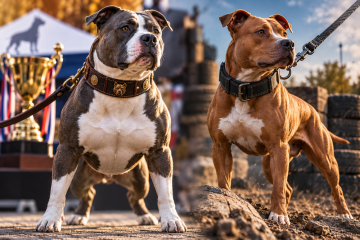
What you see on the pavement: the Amstaff tends to look broader through the chest and heavier in bone. A typical APBT looks longer in the leg, tighter in the waist and lighter on its feet. Our Amstaff growth chart with weight, height and collar size shows how an Amstaff fills out from puppy to adult.
Head, coat and colour
Both breeds have a short, stiff coat and a broad skull. The AKC Amstaff standard describes pronounced cheek muscles and a strong jaw. The APBT head tends to be more wedge-shaped and less exaggerated. On colour, the UKC accepts every APBT colour except merle. The AKC accepts any Amstaff colour, but discourages all-white, more than 80 % white, black and tan, and liver.
Temperament and drive
Both standards describe a confident, people-oriented dog, and neither describes a guard dog. The real difference is energy. Many APBT lines are bred for working drive, so expect a dog that needs a job, not just a walk. Many Amstaffs are a little steadier around the house. Both can have a low tolerance for other dogs, so slow, managed introductions matter more than in most breeds. The individual always beats the label.
Why the label matters more than you think: the law
The quick truth: in some countries the law does not care about breed standards. It cares about appearance and paperwork.
France
French law treats a dog that looks like an Amstaff but has no LOF pedigree as a category 1 dog, commonly called a "pit-bull". Buying, selling, giving away or importing one is banned and can mean up to six months in prison and a 15,000-euro fine. A pedigree Amstaff registered with the LOF falls into category 2. Both categories need a detention permit, insurance and a behavioural assessment by an approved vet between 8 and 12 months of age. In public they must be muzzled and on a lead held by an adult. The Staffordshire Bull Terrier is not categorised.
United Kingdom
The Dangerous Dogs Act 1991 bans the pit bull terrier type. Assessment is based on physical characteristics, not on papers, so an unregistered muscular bull-type dog can be examined against those criteria.
United States and elsewhere
There is no national ban in the US, but some cities and counties have breed-specific rules, and many landlords and insurers restrict "pit bull type" dogs. An FCI pedigree will not help in a city that judges by looks.
Safety note: this is general information, not legal advice. Rules change and differ by region. Always check the current regulations where you live and where you travel.
Not sure what you have? Do this now
- Find the papers. An FCI or AKC pedigree says Amstaff. A UKC or ADBA registration says APBT. No papers usually means a mix or an unknown dog, whatever the seller promised.
- Check the rules where you live. In France, an unregistered Amstaff-type dog is legally a category 1 dog. That changes everything from walks to housing.
- Measure the neck and the head. Neck in the middle with two fingers under the tape; head over the ears and forehead. If the two numbers are close, the dog can back out of a loose collar.
- Do the backwards test. With the collar on, gently pull the lead forward towards the jaw. If the collar slides over the ears, it is too loose or the wrong type.
- Watch your hand. A thin lead that leaves a red line on your palm after one lunge at a cat is too narrow for this dog.
The long game: what makes either dog easy to live with
The breed name does not walk the dog. Training does. A dog that pulls and gets where it wants has just been paid for pulling.
- Puppies: start loose-lead training early, in short sessions. Five good minutes beat half an hour with a crocodile on the end of the lead.
- Adult dogs: practise in quiet places first, then add distractions one at a time: a cyclist, a dog behind a fence, a jogger.
- Dog meetings: introduce new dogs on neutral ground, walking side by side, not face to face. Calm parallel walks beat hopeful nose-to-nose greetings.
- Energy: an underworked APBT will invent its own job. Usually you will not like the job description. Scent games, controlled tug and structured fetch work well.
Solid gear manages the moment. Only training changes what the dog does next week.
Gear for a dog with this much engine
A collar is judged in the half-second the lead goes tight. A 25-kg bull-type dog that hits the end of the lead at full speed loads the collar, the hardware and your hand all at once. Pretty in the photo, useless on the pavement: that is how most cheap gear fails. Narrow straps cut in, thin rings bend, stitching opens.
Choose by function, not by breed name. Start with the measurements from our guide to measuring your dog for a classic collar, then match the gear to the job.
For everyday control: a wide classic collar
A wider, firm leather collar spreads pressure over more of the neck. The Renegade wide leather collar for strong dogs is made to measure for necks from 26 to 60 cm, in 25, 32 or 40 mm widths, with heavy-duty hardware. For an adult Amstaff or APBT that pulls, the 32 or 40 mm width makes sense. It suits dogs whose head is clearly wider than the neck. It will not fix pulling, and it will not stop a dog with a narrow head from backing out.

For dogs that back out: a half-check collar
A half-check tightens only to a set limit when the lead goes tight, so it cannot slip over the head. The Tough Guy Choker leather half-check collar has a heavy chain and a 25 or 32 mm leather band, and it is measured by head circumference. It is the right choice when the neck and head measurements are close. It is not a correction tool: never jerk it, and never leave it on a dog that is tied up or unsupervised.

For your hand: a short, heavy lead
The collar is only half of the connection. The Goliash heavy leather lead for powerful dogs is made from 4 mm cowhide, 19 mm wide, with brass cubes for stiffness and a massive brass snap hook. It comes in 61, 92 or 122 cm. A short length keeps the dog close in town, on busy pavements and in vet waiting rooms. It gives you grip and reaction time. It does not replace loose-lead training.

Quick decision guide
- If your dog has an FCI or AKC pedigree → it is an Amstaff. Check local rules anyway, especially in France (category 2).
- If your dog has UKC or ADBA papers → it is an APBT. Expect more drive and check whether your country restricts the type.
- If there are no papers → treat the dog as an individual and treat the law as if it judges by looks, because in many places it does.
- If the head is clearly wider than the neck → a wide classic collar is usually enough.
- If neck and head measure almost the same → choose a half-check collar.
- If the dog lunges at triggers → shorten the lead, add distance, and book a trainer. Stronger gear only buys you time.
Common mistakes
- Buying by breed instead of by measurement. Two Amstaffs can differ by several centimetres in neck size. The collar fits the dog, not the breed name.
- Trusting a seller's "it's an Amstaff". Without papers, it is a promise, not a pedigree, and in France the difference can be criminal.
- Using a thin fashion lead. It looks fine until the first cat under a parked car. Then it cuts into your fingers.
- Leaving a half-check on an unsupervised dog. The loop can catch on fences and crate bars.
When to call a professional
Get help early if your dog lunges, growls or stiffens at other dogs, if pulling makes walks unsafe, or if you cannot hold the dog during a sudden lunge. A qualified trainer or a veterinary behaviourist can work on the cause. Sudden irritability or a change in behaviour may also be pain, so start with a vet check. For legal disputes, ask a local lawyer, not a breed forum.
FAQ
Is an American Staffordshire Terrier a pit bull?
Not by registration. The Amstaff is a separate breed recognised by the AKC and FCI, while the American Pit Bull Terrier is recognised by the UKC and ADBA. In everyday speech and in some laws, though, "pit bull" means a type of dog, and an Amstaff can be included in it.
Which is bigger, a pit bull or an Amstaff?
The Amstaff is usually heavier and broader at a similar height. The APBT has a wider size range: UKC males are typically 46–53 cm tall and 16–27 kg, so some are as large as an Amstaff and others are much lighter.
Can an American Pit Bull Terrier compete at FCI dog shows?
No. The FCI does not recognise the American Pit Bull Terrier as a breed, so it cannot be shown at FCI shows. APBTs are shown at UKC and ADBA events instead.
Are pit bulls legal in France?
Dogs that look like an Amstaff but have no LOF pedigree are category 1 in France. Acquiring, selling or importing them is banned. A pedigree Amstaff is category 2 and can be kept with a permit, insurance, a behavioural assessment, and a muzzle and lead in public.
What collar width suits an adult pit bull or Amstaff?
Measure the neck first. For strong adult dogs that pull, a firm leather collar around 32–40 mm wide spreads pressure better than a narrow strap. If the neck and head measurements are close, a half-check collar is safer than a classic one.
Do pit bulls and Amstaffs need more exercise than other breeds?
Both are energetic, and many APBT lines have strong working drive. Plan daily physical exercise plus mental work, such as scent games or structured play. A bored bull-type dog finds its own entertainment.
The bottom line
Same blood, different paperwork. The Amstaff and the American Pit Bull Terrier split in the 1930s over a name, and fifty years of separate breeding did the rest. Papers decide the breed, the law in your country decides how much that matters, and the neck decides the collar. Measure your dog, check your local rules, and pick gear that holds in the half-second when it counts. When you are ready, browse our leather collars for dogs that pull and choose the width that matches your dog's real strength.