Staffordshire Bull Terrier vs American Staffordshire Terrier: What’s the Real Difference?
Quick answer:
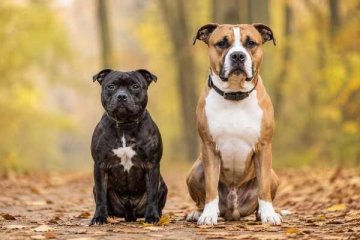
The Staffordshire Bull Terrier and the American Staffordshire Terrier share historical roots, but today they are two distinct breeds with different sizes, structure, temperament, and working style. Staffies are generally smaller, more people-focused, and more playful. Amstaffs are larger, more powerful, and often more composed in everyday life.
If you're exploring the wider world of bull-type dogs, it's worth starting with Bull-Type Dogs Guide, Part 1: The Core Bull Breeds, which explains how these breeds fit into the larger bull-dog family tree.
Staffordshire Bull Terrier vs American Staffordshire Terrier
Type this comparison into Google and you'll usually find pages filled with breed standards, measurements, and historical dates.
Useful? Sure.
But most people are actually trying to answer a much simpler question:
What are these dogs like in real life?
The answer becomes clear surprisingly quickly.
Put a mature Staffy and a mature Amstaff side by side.
They may share the same family resemblance, but they rarely give the same impression.
One feels like a compact athlete loaded with energy.
The other feels like a bigger, more powerful competitor built for a different class.
History: The Same Ancestor, Different Destination
Both breeds trace their roots back to the bull-and-terrier dogs developed in England during the nineteenth century.
Breeders crossed old bulldogs with various terrier types in search of a dog that combined strength, determination, agility, and courage.
As these dogs spread beyond Britain, their development began to diverge.
In the United Kingdom, selective breeding eventually produced the modern Staffordshire Bull Terrier.
In the United States, breeders favored larger and more substantial dogs. Over time, this development led to the American Staffordshire Terrier.
Today both breeds are officially recognized and have their own breed standards.
If you'd like to explore related bull breeds and modern bully varieties, continue with Bull-Type Dogs Guide, Part 2: Bull & Bully – The Modern Crew.
Which Breed Is Bigger?
This is one of the most searched questions about the two breeds.
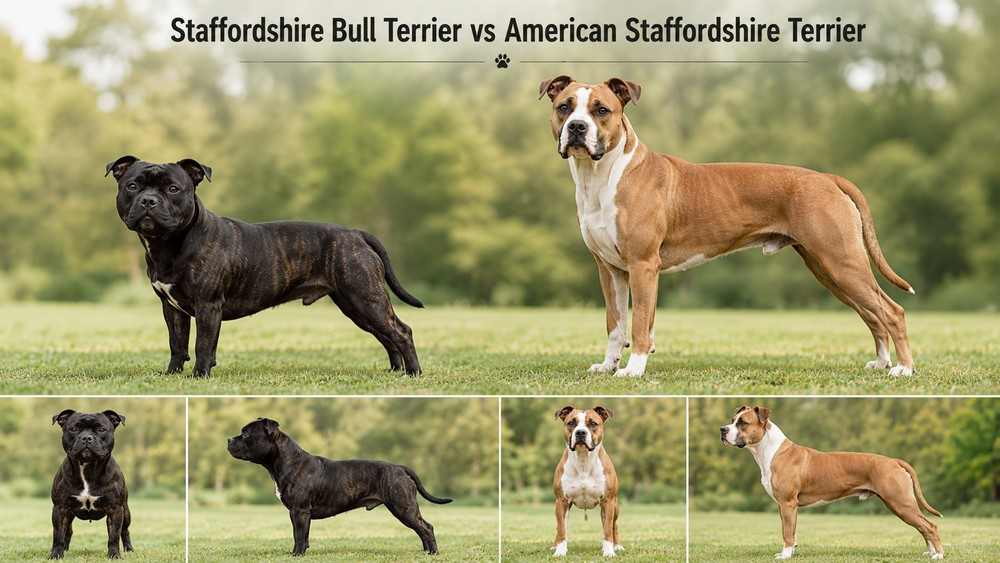
The American Staffordshire Terrier is significantly larger than the Staffordshire Bull Terrier.
Not slightly larger.
Significantly larger.
Staffordshire Bull Terrier Size
- Height: 35–40 cm (14–16 inches)
- Males: 13–17 kg (29–37 lbs)
- Females: 11–15 kg (24–33 lbs)
The Staffy is compact, muscular, and remarkably powerful for its size.
Many first-time owners are surprised by how much strength can fit into a dog weighing around fifteen kilograms.
A determined Staffy can generate far more pulling power than most people expect.
American Staffordshire Terrier Size
- Height: 43–48 cm (17–19 inches)
- Weight: 25–35 kg (55–77 lbs)
The Amstaff brings longer legs, a heavier frame, and noticeably greater overall strength.
When a fully grown Amstaff decides to lean into the leash, the difference becomes immediately obvious.
Weight is only part of the story.
Leverage, body mass, and overall power create a completely different handling experience.
Head Shape: The Fastest Way to Tell Them Apart
Many people focus on coat color or body size.
Experienced owners usually look at the head first.
Staffordshire Bull Terrier Head
Typical features include:
- Very broad skull
- Short muzzle
- Pronounced cheek muscles
- Round eyes
The overall expression tends to be softer and rounder.
It's one reason why Staffies can switch from looking tough to looking ridiculously lovable in a fraction of a second.
American Staffordshire Terrier Head
The Amstaff typically shows:
- Longer muzzle
- Longer skull
- More pronounced stop
- Sharper facial lines
The result is a cleaner, more athletic appearance.
Many people describe the Amstaff as looking more serious and mature.
How Can You Spot the Difference in Five Seconds?
If both dogs are standing next to each other, a quick visual comparison often works surprisingly well.
- The Staffordshire Bull Terrier looks like a compact spring loaded with energy.
- The American Staffordshire Terrier looks like a heavier athlete with greater physical presence.
It's a simplification, of course.
But for most people, it works remarkably well.
Why Do People Confuse Them?
The answer is simple.
They share common ancestors.
They share many physical characteristics.
Both belong to the bull-type dog family.
Both have muscular bodies and broad heads.
And both trigger the same question from strangers:
"Is that a Staffy or an Amstaff?"
However, the similarities start fading once you spend real time around them.
The differences in temperament, energy, motivation, and everyday behavior become much easier to see.
In the next section, we'll look at where those differences become impossible to ignore: personality, trainability, activity levels, social behavior, and why the same leash or collar often behaves very differently on a Staffy than it does on an Amstaff.
Temperament: This Is Where the Real Differences Begin
If appearance is what makes people confuse these breeds, temperament is what separates them.
On paper they can look similar.
In daily life they often feel very different.
What Is a Staffordshire Bull Terrier Like?
If the Staffordshire Bull Terrier could be summarized in one sentence, it would probably be this:
"A dog that believes personal space is a design flaw."
A typical Staffy is:
- extremely people-oriented
- affectionate
- playful
- energetic
- stubborn
- always ready for the next adventure
Many owners describe the breed as a dog that insists on participating in everything.
Cooking dinner?
The Staffy is there.
Watching television?
The Staffy is there.
Trying to work from home?
The Staffy has already decided your keyboard belongs to both of you.
This intense attachment to people is one of the defining characteristics of the breed.
It's also one of the reasons Staffordshire Bull Terriers have earned such a loyal following among families.
What Is an American Staffordshire Terrier Like?
The American Staffordshire Terrier is also deeply devoted to its family.
It simply tends to express that loyalty differently.
Many Amstaffs appear:
- calmer
- more composed
- more self-assured
- more observant
- slightly more reserved around strangers
While a Staffy may greet visitors as if they have returned from a five-year expedition, an Amstaff is often more likely to observe first and decide later.
This shouldn't be confused with aggression.
It's usually confidence.
And confidence often looks quieter than excitement.
Which Breed Is More Affectionate?
Both breeds can be extremely affectionate.
However, the Staffordshire Bull Terrier often takes attachment to another level.
Many Staffy owners eventually accept one simple fact:
The dog is no longer sharing the sofa.
The dog owns the sofa.
And possibly the bed.
And most of the available floor space.
A Staffy rarely wants to be near its people.
It usually wants to be on them.
Energy Levels and Activity
Neither breed is suitable for a purely sedentary lifestyle.
Both need exercise, mental stimulation, and meaningful interaction.
The difference lies in how that energy is expressed.
Staffordshire Bull Terrier Energy
Many Staffies seem convinced they are puppies forever.
They love:
- running
- fetch games
- tug toys
- family activities
- interactive play
They often combine explosive energy with a great sense of humor.
When bored, they can become surprisingly creative.
Unfortunately, their creativity may involve shoes, cushions, blankets, or anything else they find interesting.
A tired Staffy is usually a happy Staffy.
An under-stimulated Staffy often invents its own entertainment.
American Staffordshire Terrier Energy
The Amstaff is also an athletic breed.
The difference is that its energy often feels more controlled.
Many Amstaffs excel in:
- long hikes
- obedience work
- canicross
- weight-pulling sports
- structured training activities
Their greater size and strength allow them to sustain demanding physical activity exceptionally well.
For active owners, this combination of power and athleticism is often one of the breed's biggest attractions.
Trainability: Intelligence Is Not the Problem
One of the most common questions is:
Which breed is easier to train?
The answer depends largely on motivation.
Training a Staffordshire Bull Terrier
Staffies are intelligent dogs.
Very intelligent.
The challenge is that they frequently use that intelligence to negotiate.
A typical Staffy thought process may look something like this:
"I understand exactly what you're asking. Now explain why I should do it."
When motivation is strong, they learn remarkably fast.
When motivation is weak, they can suddenly become experts at selective hearing.
This independent streak is part of their charm.
And occasionally part of their owner's frustration.
Training an American Staffordshire Terrier
Many Amstaffs tend to stay focused longer during training sessions.
They often show:
- greater task focus
- better concentration
- strong work ethic
- good responsiveness
This is one reason they are frequently successful in organized dog sports and obedience disciplines.
That doesn't mean every Amstaff is easier than every Staffy.
It simply reflects a trend that experienced trainers often notice.
Living With Other Dogs: Reality Matters More Than Wishful Thinking
This is where honesty is important.
Neither breed was historically developed as a universal dog-park social butterfly.
Many individuals live peacefully with other dogs.
Many enjoy canine company throughout their lives.
Others are far more selective.
Both outcomes are normal.
Success depends heavily on:
- early socialization
- consistent training
- responsible management
- respecting individual personality
The biggest mistake is assuming every Staffy or every Amstaff will automatically love every dog they meet.
Some do.
Some don't.
Good ownership means understanding the difference.
Health Considerations
Both breeds are generally robust dogs, but each has health concerns that prospective owners should understand.
Staffordshire Bull Terrier Health
Conditions seen more frequently include:
- L-2-HGA
- Hereditary cataracts
- Skin allergies
- Various dermatological issues
Responsible breeders commonly use genetic testing to reduce these risks.
American Staffordshire Terrier Health
Potential concerns include:
- Hip dysplasia
- Elbow dysplasia
- Heart conditions
- Skin problems
This is why choosing a responsible breeder matters far more than choosing a fashionable color or bloodline trend.
Decision Flow: Which Breed Fits You Better?
- Want a smaller, highly people-oriented companion? → Staffordshire Bull Terrier.
- Want a larger and more physically powerful dog? → American Staffordshire Terrier.
- Love constant interaction and close contact? → Staffordshire Bull Terrier.
- Looking for greater physical capability and sporting potential? → American Staffordshire Terrier.
- Still undecided? → Focus on temperament first, breed name second.
If you're interested in the broader bull-dog family and how these breeds relate to others, continue with Bull-Type Dogs Guide, Part 4: The Wider Relatives and the Heavy Hitters.
What Kind of Collar Works Best for a Staffy and an Amstaff?
This is one of those questions many owners don't think about until the first time their dog really commits to pulling.
Until then, most collars seem fairly similar.
Then reality arrives.
A squirrel appears.
A rabbit crosses the path.
Another dog shows up unexpectedly.
And suddenly the difference between a collar that looks good and a collar that works becomes very obvious.
Choosing a Collar for a Staffordshire Bull Terrier
The Staffordshire Bull Terrier presents a unique challenge.
Its neck is often nearly as wide as its head.
That combination allows some Staffies to back out of collars that appear perfectly secure.
Owners are frequently surprised by how efficiently a determined Staffy can reverse out of equipment that fits many other breeds without issue.
When a Staffy suddenly changes direction or throws its weight into the leash, a narrow collar can rotate surprisingly quickly.
In some cases, it turns almost ninety degrees within seconds.
That's why broader, more stable leather collars often perform better on this breed.
For many Staffordshire Bull Terriers, designs such as the Classic Outlaw Collar provide greater stability and improved pressure distribution around the neck.
Active dogs that spend a lot of time outdoors frequently do well with the Classic Jolly Jumper Collar, while owners looking for a stronger visual presence often prefer the Simply Stunning Classic Collar.
The key isn't decoration.
The key is keeping the collar stable when the dog decides to test it.
Choosing a Collar for an American Staffordshire Terrier
The Amstaff adds another factor to the equation.
Mass.
And with that mass comes significantly more force.
A thirty-kilogram dog accelerating into a leash creates a completely different load than a fifteen-kilogram dog doing the same thing.
This is where construction quality becomes critical.
Not because the dog is difficult.
Because physics doesn't negotiate.
For many Amstaffs, wider and more substantial designs such as the Hexagon Classic Collar offer excellent support and stability.
Dogs with particularly strong necks often benefit from the broader profile of the Beefy Bang Bang Classic Collar.
Owners looking for a versatile everyday option frequently choose the Smart Casual Collar, which balances practicality with a cleaner appearance.
How Can You Tell a Collar Is Wrong in Five Seconds?
There's a simple real-world test.
Take your dog for a normal walk.
Wait for the first genuinely excited reaction.
Then watch what the collar does.
If it:
- rotates around the neck,
- slides to one side,
- creates pressure in a narrow line,
- moves under the throat,
- or constantly changes position,
the problem may not be the dog.
The problem may be the collar itself.
Many owners assume they need more training.
Sometimes they simply need better equipment.
Looks Good in Photos vs Works in Real Life
This is one of the biggest differences between decorative gear and functional gear.
Many collars look fantastic in photographs.
Everything appears perfect while the dog is standing still.
The lighting is good.
The posture is perfect.
Nothing is moving.
Then real life begins.
The dog spots something interesting.
It launches forward.
Its chest drives into the leash.
The collar twists.
Pressure concentrates into a narrow area.
Control decreases.
Comfort decreases.
The photo is still beautiful.
The experience isn't.
A collar can impress people online. A properly built collar proves itself when the unexpected happens.
Common Mistakes Owners Make
Choosing Appearance Over Function
Color is enjoyable.
Design is personal.
Construction is what actually matters when the dog moves.
A collar is daily equipment, not a decorative accessory.
Using a Collar That's Too Narrow
The stronger the dog, the more pressure distribution matters.
A narrow collar may work perfectly on one breed and perform poorly on another.
Neck shape changes everything.
Underestimating Adult Strength
A young puppy may seem easy to handle.
An adult Amstaff is a very different animal.
Many owners buy equipment for the dog they have today instead of the dog they will have in twelve months.
Trying to Solve Every Problem With Collar Type
Sometimes owners spend weeks debating between a standard collar and a half-check design.
Meanwhile, the real issue is width.
Or fit.
Or sizing.
The wrong size of the right collar often performs worse than the correct size of a simpler design.
Professional Perspective: What Experience Teaches
After years of producing leather gear for bull-type dogs, one pattern appears again and again.
Owners focus on decoration.
Studs.
Crystals.
Color combinations.
Fancy hardware.
Yet the biggest difference in everyday use usually comes from something much less glamorous.
Width.
Balance.
Pressure distribution.
And how the collar interacts with the individual dog's neck structure.
Your dog doesn't care how many decorative details are on the collar.
Your dog immediately notices whether the collar stays stable when thirty kilograms of enthusiasm suddenly head in the opposite direction.
That's the difference between an accessory and working equipment.
Who Is the Staffordshire Bull Terrier Best For?
The Staffordshire Bull Terrier is often the better choice for people who want a dog fully involved in everyday family life.
Not a yard dog.
Not a dog that prefers independence.
Not a dog content to watch life from a distance.
A Staffy wants to participate.
In everything.
If you're looking for a companion that forms exceptionally strong bonds with people, the Staffordshire Bull Terrier often excels.
- Families looking for an active companion
- Owners who enjoy close interaction with their dog
- People wanting a smaller but remarkably strong breed
- Those looking for a playful and affectionate character
- Owners who don't mind having a permanent shadow with four legs
Who Is the American Staffordshire Terrier Best For?
The American Staffordshire Terrier often appeals to people looking for greater physical presence.
Not necessarily a tougher dog.
Simply a larger one.
With more strength, more leverage, and often more athletic potential.
- Experienced dog owners
- Active individuals and sports enthusiasts
- People wanting a larger companion
- Owners interested in canine sports
- Those comfortable handling a physically powerful breed
If You're Torn Between a Staffy and an Amstaff
The biggest mistake people make is focusing entirely on appearance.
Both breeds look impressive.
Both are muscular.
Both have strong visual presence.
But appearance isn't what you'll live with every day.
The better question isn't:
"Which one looks better?"
The better question is:
"Which one fits my lifestyle for the next ten to fifteen years?"
Energy levels, exercise requirements, trainability, handling strength, and personality have a far greater impact on everyday life than coat color or head shape.
Your Next Step: Understanding the Wider Bull-Type Family
If this comparison helped clarify the difference between Staffies and Amstaffs, you're only seeing part of the picture.
The wider bull-type family contains several related breeds that share common ancestry while developing very different personalities and physical characteristics.
To continue exploring the topic, we recommend:
- Bull-Type Dogs Guide, Part 1: The Core Bull Breeds
- Bull-Type Dogs Guide, Part 2: Bull & Bully – The Modern Crew
- Bull-Type Dogs Guide, Part 4: The Wider Relatives and the Heavy Hitters
Understanding these relationships makes it much easier to see why Staffies and Amstaffs look similar while behaving quite differently.
Final Summary
The Staffordshire Bull Terrier and the American Staffordshire Terrier share common roots, but today they are distinct breeds with different strengths, different personalities, and different lifestyles.
The Staffy is generally smaller, more playful, more people-focused, and often hilariously attached to its family.
The Amstaff brings greater size, more physical power, and frequently a calmer sense of confidence.
Neither breed is universally better.
Each suits a different type of owner.
What they do share is loyalty.
Give either breed proper leadership, enough activity, and a secure place within the family, and you'll gain a companion capable of extraordinary devotion.
Your dog doesn't read breed standards. It simply wants to know where it belongs.
Frequently Asked Questions
Is a Staffordshire Bull Terrier the same breed as an American Staffordshire Terrier?
No. They are separate breeds recognized under different standards, with different size ranges, structure, and temperament.
Which breed is larger?
The American Staffordshire Terrier is considerably larger, heavier, and more physically powerful.
Which breed is better with children?
Both breeds can be excellent family dogs when properly raised and socialized. Staffies are often particularly people-oriented.
Which breed requires more exercise?
Both are active dogs. The Amstaff often handles more demanding physical activities because of its larger frame and strength.
Can Staffies and Amstaffs live with other dogs?
Yes, but successful coexistence depends on socialization, training, management, and the personality of the individual dog.
What collar width is suitable for a Staffordshire Bull Terrier?
Many adult Staffies do well with collars in the 30–40 mm range, depending on neck structure and individual size.
What collar width is suitable for an American Staffordshire Terrier?
Many adult Amstaffs benefit from collars in the 40–50 mm range combined with strong hardware and stable construction.
Why does my dog's collar keep rotating?
The collar may be too narrow, too loose, or simply unsuited to the shape of your dog's neck and head.