Why Does My Dog Follow Me Everywhere? 7 Real Reasons
Short answer:
Your dog follows you everywhere because you are the centre of their routine, safety, attention and rewards. In most cases it is normal attachment, but if the dog panics when you leave, blocks your movement, whines, trembles or cannot settle alone, it may point to stress or separation-related behaviour.
Why does my dog follow me everywhere?
A dog follows you everywhere because your movement means something. You may be heading to food, the leash, the door, the sofa, the car or the magic place where treats appear. Dogs do not follow randomly. They follow patterns, body language and tiny signals we do not even know we are sending.
If this behaviour is calm, loose and easy to interrupt, it is usually nothing dramatic. If your dog shadows you like a furry security guard with anxiety issues, the next step is to look at the reason behind it. For wider behaviour and gear guidance, the Slade Czech guides are a useful place to continue.
1. Your dog feels safe near you
The simplest reason is safety. You are the familiar person, the stable smell, the predictable voice and the one who knows where the door opens.
You see it when the dog relaxes near your feet, follows you from room to room and settles again once you stop moving. That is not drama. That is trust wearing paws.
2. Your dog has learned your routine
Dogs are brutal little routine experts. Pick up keys, move toward the hallway, touch the treat drawer, change shoes — and your dog reads the whole script before you say a word.
The 5-second test is simple: stand up, take two steps toward the kitchen and watch the ears. If they switch on like radar, your dog is not guessing. Your dog is tracking the pattern.
3. Your dog expects food or treats
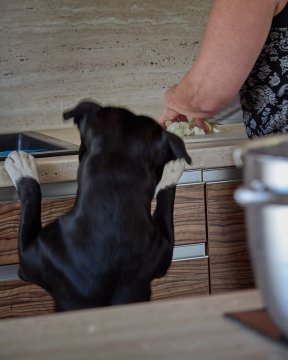
Some dogs follow because history paid well. A crumb dropped once, a snack given twice, and suddenly your kitchen walk has become a full-time canine investment plan.
If you use treats for training, keep them practical and controlled. The Snack Strap makes sense when you want rewards ready without turning every pocket into a greasy biscuit crime scene.
4. Your dog wants attention
Following can be a request: look at me, touch me, speak to me, do something. This is common in dogs that have learned that standing under your feet gets a reaction.
Even a frustrated “move!” is attention. And yes, some dogs will happily take that deal. To them, a reaction is still a win.
5. Your dog is bored
A bored dog follows because you are the only moving object in the house worth studying. Door? Interesting. Laundry basket? Interesting. Human going to the bathroom? Apparently premium cinema.
This is where short training, sniffing games, calm leash work and clear daily rituals help. A dog that gets useful work for the brain is less likely to become your four-legged shadow with overtime.
6. Your dog may struggle with being alone
If your dog follows calmly, that is one thing. If they panic when a door closes, bark, scratch, drool, tremble or cannot rest unless you are visible, it may be separation-related stress.
This is not stubbornness. It is a nervous system problem. The goal is not to “show who is boss”, but to teach the dog that alone time is safe, boring and survivable.
7. Some breeds are naturally more people-focused
Many bull-type dogs, including Staffordshire Bull Terriers, can be extremely people-oriented. They often want contact, action and a front-row seat in whatever their human is doing.
That closeness can be brilliant. But it needs structure. A strong dog with no off-switch can turn affection into hallway traffic control very quickly.
Quick decision flow
- If your dog follows calmly and settles easily: it is probably normal attachment. Keep routines clear and reward calm behaviour.
- If your dog follows mainly near the kitchen: check your treat habits. Food timing may be training your shadow better than you think.
- If your dog blocks your legs or jumps up: teach a place cue and reward distance, not chaos under your feet.
- If your dog panics when left alone: treat it as stress, not mischief, and work gradually.
- If walks are where the chaos starts: the problem may move from behaviour to handling; compare collar choice and control in the collar and leash advice section.
Common mistakes
Rewarding the shadow without noticing
If the dog follows and gets food, touch, eye contact or a laugh every time, the behaviour gets paid. What gets paid gets repeated. Simple. Slightly annoying. Very dog.
Confusing affection with anxiety
A relaxed follower is not the same as a panicking dog. The difference shows in seconds: soft body, loose tail and easy settling are normal; whining, pacing and door-scratching are not.
Letting the dog control every movement
If your dog blocks the hallway, rushes through doors or glues themselves to your knees, it is no longer cute companionship. It is household traffic management with fur.
Using treats with no structure
Treats are tools, not confetti. Keep rewards deliberate. A practical holder like the Snack Strap for clean, quick reward access helps when treats support training instead of random begging.
What looks cute versus what works in real life
A dog following you from room to room looks sweet on video. In real life, it can become tripping, door rushing, kitchen begging or nervous watching. Cute is the photo. Function is whether the dog can relax when nothing happens.
Expert view
From real dog life, the difference is rarely in one big moment. It is in tiny repeats. The dog follows, the human reacts, the dog learns. Then one day the owner says: “He is always under my feet.” No mystery. Just training that happened without a plan.
At Slade Czech, we look at dogs through practical behaviour: pulling, pressure, control, movement, contact and the moment gear or routine gets tested. Whether it is a collar, leash or treat setup, the question is always the same: does it work when the dog actually does dog things?
That practical view is also part of our story — it did not start as polished catalogue talk, but as hands-on work with dogs, leather and daily use.
Who this advice is useful for
- Owners whose dog follows them from room to room but stays relaxed.
- People dealing with a dog that begs, blocks legs or camps in the kitchen.
- Owners of people-focused breeds that love being close but need boundaries.
- Families where dog movement around children needs calm rules; the article about living together with a child and a dog is the next sensible read.
- Handlers who want treats ready for training without feeding chaos by accident.
Final summary
A dog that follows you everywhere is usually showing attachment, habit, curiosity or reward expectation. The key is to read the body language: calm following is normal, anxious shadowing needs attention. If the behaviour creates chaos, teach calm distance, use rewards deliberately and build routines the dog can understand.
The goal is not to stop your dog loving your company. The goal is to make sure your dog can love your company without becoming your ankle-mounted alarm system.
Frequently asked questions
Why does my dog follow me to the bathroom?
Because your dog sees movement and wants to stay close. It can be habit, curiosity, attachment or the simple belief that every closed door is suspicious.
Is it bad if my dog follows me everywhere?
Not always. Calm following is usually normal. It becomes a problem when the dog cannot relax alone, panics behind doors or blocks your movement.
How do I stop my dog from following me all the time?
Teach a place cue, reward calm distance, avoid feeding the behaviour accidentally and build short moments where the dog rests without watching every step.
Does following mean my dog has separation anxiety?
Following alone does not prove separation anxiety. Panic, barking, scratching, drooling, trembling or destruction when left alone are stronger warning signs.
Can treats make my dog follow me more?
Yes. If your dog often gets snacks after following you, the behaviour is being rewarded. Use treats deliberately, not as random payments for shadow duty.