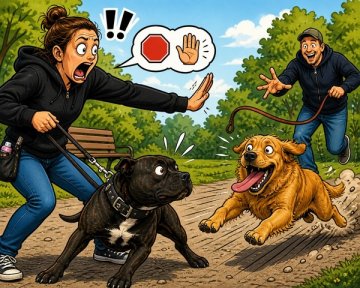
“He’s Friendly” — Until He Slams Into Your Dog
Short answer:
To stand up for your dog, stay calm, create distance, block pressure before contact happens, and give clear instructions to the other owner. Your dog should not be forced to “say hello” just because another dog is loose, excited, or badly managed.
If your dog reacts strongly on the leash, start with control, space, and predictable gear. A dog that can lean into the leash with the whole chest needs equipment that does not twist, collapse, or turn a stressful moment into a wrestling match.
How do you protect your dog when another dog runs up?
You protect your dog by taking control early: move away, place yourself between the dogs, use a firm voice, and ask the other owner to call their dog back. The goal is not drama. The goal is distance, control, and preventing a forced greeting before your dog feels trapped.
If this happens often, look at the whole walking setup, not only the dog’s behaviour. A strong dog in a loose, soft, narrow collar can turn one sudden lunge into a mess within seconds. For dogs that hit the leash hard, a proper collar choice for a strong Staffordshire Bull Terrier is not about looking tough. It is about staying readable when the street suddenly becomes interesting.
What should you say when someone shouts “He is friendly”?
Answer clearly and early: “Please call your dog back.” That sentence is simple, polite, and hard to misunderstand.
Do not explain your dog’s whole life story while the other dog is already closing the gap. Say what needs to happen. If the owner keeps talking, repeat the same instruction. Your dog does not need a committee meeting. Your dog needs space.
Should you let dogs meet if one dog is off leash?
No, not automatically. A greeting is only fair when both dogs are under control and both handlers agree.
An off-leash dog running straight at a leashed dog creates pressure. The leashed dog cannot choose distance, turn freely, or escape calmly. That is when even a normally steady dog may stiffen, bark, freeze, or snap. It is not “bad manners.” It is a trapped dog making a fast decision.
How do you create space without making things worse?
Move with purpose, not panic. Turn away, step behind a parked car, cross the road if safe, or put your body between your dog and the approaching dog.
Teach your dog a simple “behind me” position. In real life it looks boring, which is perfect. Your dog steps behind your leg, you shorten the leash without yanking, and you become the front line. That small move can change the whole picture in five seconds.
What gear helps when your dog suddenly pulls?
Gear helps when it stays stable under pressure. It should guide the dog without twisting, choking, collapsing, or sliding into the wrong position.
Here is the 5-second test: if your dog leans forward and the collar rotates 90°, folds into a narrow strip, or sends all pressure into one sharp line, the problem is not just looks. You lose timing, the dog feels messy pressure, and your handling gets late.
For calmer dogs with decent leash manners, a firm classic leather dog collar for everyday control can be enough. For dogs that back out, test boundaries, or hit the end of the leash with force, a leather half check collar for stronger leash moments may make more sense when used correctly.
Decision flow: what should you choose?
- If your dog mostly walks calmly but needs reliable handling: choose a firm classic collar that does not roll or stretch under normal leash pressure.
- If your dog pulls with the whole chest, twists the collar, or explodes toward other dogs: first solve width, fit, and construction before blaming training alone.
- If your dog slips backward, tests the leash, or suddenly hits the end hard: consider a half check collar, but only with correct sizing and calm handling.
- If you are not sure what the real problem is: check whether the collar turns, collapses, or concentrates pressure into one line within five seconds.
If the main issue is pulling, the next useful step is not guessing. Read how leash pressure works in practice in how to stop a strong dog from pulling on the leash, then compare whether your current collar actually supports that training or quietly sabotages it.
Common mistakes
Waiting until the loose dog is already close
The mistake is hoping the situation will solve itself. It usually does not. Once the other dog is only a few steps away, your options shrink fast and your dog may already be loading pressure into the leash.
Arguing with the other owner in the middle of the moment
The mistake is spending energy on the human while the dogs are still moving. Handle the dogs first. Words later, if needed. A calm exit beats a perfect argument every time.
Using a collar that looks good but folds under real pull
A narrow or soft collar may look neat in photos, but in real tension it can twist, slide, and dig into one line on the neck. You feel it immediately: the leash angle goes ugly, the dog’s head turns badly, and your control arrives half a second too late.
Letting every dog greet “to keep things friendly”
Forced greetings do not build confidence. They teach the dog that personal space is negotiable and that the leash means being stuck while strangers rush in.
What looks good versus what works
Some gear looks clean, soft, and harmless on a calm dog standing still. Real walking is different. The test comes when a dog launches toward another dog, braces into the lead, or swings sideways with full body weight. Good-looking gear decorates the moment. Working gear keeps the moment under control.
Expert view
In practice, the difference shows up fast. A stable collar keeps its shape when the dog loads pressure into it. A weak collar changes shape before the handler even reacts. That tiny delay matters because leash handling is all about timing: one second early feels calm, one second late feels like firefighting.
Standing up for your dog is not about being loud. It is about being predictable. Your voice, your position, your leash length, and your gear all send the dog the same message: stay with me, I have this.
Who is this approach for?
- Dogs that get tense when unfamiliar dogs run straight at them.
- Strong breeds that can move the handler with one sudden lunge.
- Owners who want to avoid forced greetings and leash chaos.
- Dogs that need clear space, not random sidewalk social events.
- Handlers who want control without turning every walk into a battle scene.
Final summary
Standing up for your dog means acting before the situation gets loud. Create distance, use clear words, keep your dog behind or beside you, and do not waste the key moment arguing. If your dog is strong, make sure the collar and leash setup stay stable when pressure hits. Calm is not doing nothing; calm is being ready before the street turns into a circus.
For the next step, compare your dog’s behaviour with your equipment. If the dog pulls, start with leash training; if the collar moves, collapses, or twists, solve the construction first.
Frequently asked questions
How do I stop another dog from running up to my dog?
Move away early, place yourself between the dogs, and clearly ask the owner to call their dog back. Do not wait until the dogs are nose to nose.
Is it rude to refuse a dog greeting?
No. Your dog does not have to meet every dog. A controlled walk is more important than pleasing a stranger for ten awkward seconds.
What should I do if my dog reacts on the leash?
Create more distance, reduce pressure, and avoid forced greetings. If reactions happen often, combine training with stable walking gear that does not twist under pull.
Can a collar make stressful dog encounters worse?
Yes. A collar that folds, slides, or concentrates pressure can make the dog feel more trapped and make handling less precise.
When is a half check collar useful?
A half check collar can help dogs that slip backward, test the leash, or suddenly hit the end hard, but only when correctly fitted and handled calmly.