Pit Bull vs. Amstaff: What Actually Separates the APBT From the American Staffordshire Terrier?
Quick answer: The American Pit Bull Terrier and the American Staffordshire Terrier come from the same 1800s bull-and-terrier dogs. What split them was paperwork, not blood. The UKC has registered the APBT since 1898. The AKC took the same dog in 1936, called it the Staffordshire Terrier, and renamed it in 1972. Today's Amstaff is usually heavier and show-bred, the APBT leaner and more athletic, and local law often cares more about looks than pedigree.
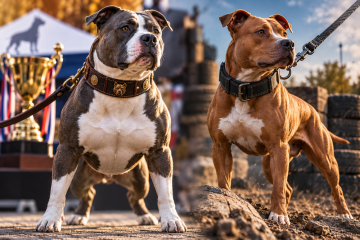
Here is the scene. Two blocky dogs on the same sidewalk, both with heads like cinder blocks and necks like fire hydrants. A squirrel bolts across the grass. Both dogs hit the end of the leash at the same second, and both owners find out exactly how good their snap is. One dog has AKC papers that say Amstaff. The other has UKC papers that say American Pit Bull Terrier. To the squirrel, and to a lot of city ordinances, they are the same dog.
So what is actually different? This guide breaks it down: where the breeds came from, how they are built, how they act, and why the label can matter more to your landlord than to any show judge. Still mixing up the British cousin? Read our Staffordshire Bull Terrier vs Amstaff breakdown first. This one handles the American side of the family.
One family, two registries
Both breeds trace back to the bull-and-terrier dogs of 19th-century England. Immigrants brought them to America, where they were bred for grit, power and agility.
- 1898: the UKC. The United Kennel Club was the first registry to recognize the American Pit Bull Terrier. Founder C. Z. Bennett gave registration number 1 to his own dog, Bennett's Ring.
- 1936: the AKC. The American Kennel Club accepted the same kind of dog but dropped the word "pit" and called it the Staffordshire Terrier. For decades, plenty of dogs were dual-registered with both clubs.
- 1972: "American" gets added. The AKC renamed the breed American Staffordshire Terrier to separate it from the smaller English Staffordshire Bull Terrier.
- 1970s onward: the door closes. Only AKC-registered parents can produce AKC Amstaffs. From there, the two populations were bred toward different goals.
Half a century of separate breeding changes a dog. Amstaff breeders chased the show ring and a consistent look. A lot of APBT breeders kept selecting for athletic performance. Result: cousins who still look related, but are no longer identical twins.
One more thing if you ever show or travel abroad: the FCI, which runs most international shows, recognizes the Amstaff but not the APBT. Outside the UKC and ADBA world, a registered American Pit Bull Terrier has nowhere to compete.
Head to head: the real differences
Bottom line first: the Amstaff is the stockier, heavier-boned show version. The APBT is the leaner, more variable working version.
Size and weight
The Amstaff standard is tighter. The AKC prefers 18 to 19 inches at the shoulder for males and 17 to 18 inches for females. It sets no official weight, only proportion, but most adult males land around 50 to 70 pounds.
The UKC gives the APBT more room: males usually 18 to 21 inches and 35 to 60 pounds, females 17 to 20 inches and 30 to 50 pounds. The standard even says balance matters more than hitting exact numbers.
On the sidewalk, the Amstaff tends to look wider through the chest and heavier in the bone. A typical APBT looks longer in the leg, tighter at the waist and quicker on its feet. Want the numbers month by month? Our Amstaff growth chart for puppy weight, adult size and collar fit lays it out.
Papers and recognition
The Amstaff is recognized by the AKC and the FCI. The American Pit Bull Terrier is recognized by the UKC and the ADBA, not by the AKC or FCI. Here is the hard truth: papers are the only reliable way to tell a purebred of one from the other. Eyeballing it does not cut it, even for people who think they are experts.
Head, coat and color
Both have a short, stiff coat and a broad skull. The AKC Amstaff standard calls for pronounced cheek muscles and a strong jaw. APBT heads tend to be more wedge-shaped and less exaggerated. Color rules differ too. The UKC accepts any APBT color except merle. The AKC accepts any Amstaff color but discourages all-white, more than 80 percent white, black and tan, and liver.
Temperament and drive
Neither standard describes a guard dog. Both describe a confident dog that likes people. The real gap is horsepower. Many APBT lines are bred for working drive, so plan on giving the dog a job, not just a walk around the block. Many Amstaffs are a notch calmer indoors. Both can have low tolerance for other dogs, so slow, controlled introductions matter. The dog in front of you always beats the breed label.
Why the label matters: the law
The short version: a lot of laws do not read breed standards. They read appearance and paperwork.
United States
There is no federal ban, but some cities and counties still have breed-specific rules. Many landlords, HOAs and homeowner's insurance policies restrict "pit bull type" dogs, and an AKC pedigree will not always get your Amstaff off that list. Before you sign a lease, switch insurers or move across state lines, read the fine print and the local ordinance.
France
Heading to France with your dog? French law classifies a dog that looks like an Amstaff but has no French LOF pedigree as category 1, commonly called a "pit-bull". Buying, selling, giving away or importing one is banned, with penalties up to six months in prison and a 15,000-euro fine. A pedigreed Amstaff falls into category 2. Both categories need a permit, insurance and a behavioral assessment by an approved vet between 8 and 12 months old, and must be muzzled and leashed by an adult in public.
United Kingdom
The Dangerous Dogs Act 1991 bans the pit bull terrier type. Assessment is based on physical traits, not papers.
Heads up: this is general information, not legal advice. Laws change and vary by city and country. Check current local rules before you move or travel.
Not sure what you've got? Start here
- Dig out the papers. AKC or FCI means Amstaff. UKC or ADBA means APBT. No papers usually means a mix or an unknown, no matter what the breeder or rescue listing said.
- Check your lease, your HOA and your insurance. These hit owners far more often than a show judge ever will.
- Measure neck and head. Neck in the middle with two fingers under the tape; head over the ears and forehead. If the numbers are close, your dog can slip a loose collar.
- Run the slip test. Collar on, pull the leash gently forward toward the jaw. If the collar rides over the ears, it is too loose or the wrong style.
- Check your palm. If a skinny leash leaves a red line after one lunge at the mail carrier, it is too narrow for this dog.
The long game: what makes either dog easy to own
The breed name does not walk the dog. Training does. A dog that pulls and gets to the fire hydrant just got paid for pulling.
- Puppies: start loose-leash training early in short sessions. Five good minutes beat thirty minutes of tug-of-war on the sidewalk.
- Adults: practice somewhere boring first, then add one distraction at a time: a bike, a dog behind a fence, a jogger with earbuds.
- Meeting dogs: walk side by side on neutral ground. Skip the face-to-face greeting at the dog park gate.
- Energy: an under-exercised APBT invents its own job, and you will not love the job description. Scent work, structured tug and flirt-pole sessions work well.
Good gear handles the moment. Only training changes next week.
Gear for a dog this strong
A collar earns its keep in the half-second the leash snaps tight. A 55-pound bull-type dog hitting the end of the leash at full speed loads the collar, the hardware and your hand at the same time. Looks great online, folds on the sidewalk: that is how most cheap gear fails. Skinny straps dig in, rings bend, stitching quits.
Pick gear by job, not by breed name. Start with our guide to measuring your dog for a classic collar, then match the tool to the problem.
Problem: daily pulling. Fix: a wide classic collar
A firm, wide leather collar spreads pressure across more of the neck. The Renegade wide leather collar for strong pullers is made to measure for necks from about 10 to 23.5 inches, in 1, 1.3 or 1.6 inch widths, with heavy-duty hardware. For an adult Amstaff or APBT that leans into the leash, go 1.3 or 1.6 inches. It fits dogs whose head is clearly wider than the neck. It will not stop pulling, and it will not keep a narrow-headed dog from backing out.

Problem: a dog that backs out. Fix: a half-check collar
A half-check tightens only to a set limit when the leash goes tight, so it cannot slide over the head. The Tough Guy Choker leather half-check collar with heavy chain comes in 1 or 1.3 inch widths and is sized by head circumference. Use it when neck and head measurements are close. It is not a correction tool: no leash pops, and never leave it on a dog that is tied out or alone.

Problem: your hand. Fix: a short, heavy leash
The collar is only half the connection. The Goliash heavy leather leash for powerful dogs is cut from 4 mm cowhide, 0.75 inch wide, with brass cubes for stiffness and a massive brass snap. It comes in 24, 36 or 48 inches. The short length keeps your dog close on busy sidewalks, at crosswalks and in the vet lobby. It buys you grip and reaction time. It does not replace leash training.

Decision cheat sheet
- AKC or FCI papers → Amstaff. Still check your lease, insurer and city code.
- UKC or ADBA papers → APBT. Plan for more drive and check where the type is restricted before travel.
- No papers → judge the dog as an individual, and assume the law judges by looks, because it often does.
- Head clearly wider than neck → a wide classic collar usually does the job.
- Neck and head almost the same → go with a half-check.
- Dog lunges at triggers → shorten the leash, add distance and book a trainer. Stronger gear only buys time.
Mistakes we see all the time
- Buying by breed instead of by tape measure. Two Amstaffs can be inches apart in neck size.
- Taking "it's an Amstaff" at face value. No papers, no proof. And in places like France, that difference carries legal weight.
- Running a thin fashion leash. Fine until the first cat under a parked truck. Then it slices your fingers.
- Leaving a half-check on an unsupervised dog. The loop can snag on fences or crate wire.
When to bring in a pro
Get help early if your dog lunges, growls or freezes at other dogs, if pulling makes walks unsafe, or if you cannot hold the dog during a sudden bolt. A certified trainer or a veterinary behaviorist can work on the root cause. A sudden change in mood can also mean pain, so start with your vet. For housing or insurance disputes over breed labels, a local attorney or your insurer, not a breed forum, is the right call.
FAQ
Is an Amstaff the same as a pit bull?
Not on paper. The Amstaff is a separate breed recognized by the AKC and FCI, while the American Pit Bull Terrier is recognized by the UKC and ADBA. But many laws, landlords and insurers use "pit bull" for a whole type of dog, and that often includes Amstaffs.
Is a pit bull or an Amstaff bigger?
At the same height, the Amstaff is usually heavier and broader. The APBT varies more: UKC males run about 18 to 21 inches and 35 to 60 pounds, so some match an Amstaff and others are far lighter.
Are pit bulls banned in the United States?
There is no federal ban. Some cities and counties have breed-specific rules, and many landlords, HOAs and insurers restrict pit bull type dogs. Always check the local ordinance and the fine print in your lease and policy.
Can an American Pit Bull Terrier be shown at FCI or AKC shows?
No. Neither the FCI nor the AKC recognizes the American Pit Bull Terrier. APBTs are shown at UKC and ADBA events.
What collar width does an adult pit bull or Amstaff need?
Measure the neck first. For strong adult pullers, a firm leather collar about 1.3 to 1.6 inches wide spreads pressure better than a narrow strap. If neck and head measure almost the same, a half-check collar is the safer pick.
How much exercise do pit bulls and Amstaffs need?
A lot. Both are energetic, and many APBT lines have strong working drive. Plan daily physical exercise plus brain work, such as scent games or structured tug. A bored bull breed will find its own entertainment.
The takeaway
Same family, different paperwork. The Amstaff and the American Pit Bull Terrier split over a name in the 1930s, and fifty years of separate breeding did the rest. Papers tell you the breed, local rules tell you what that label costs, and the tape measure tells you the collar. Measure your dog, read your lease, and pick gear that holds in the half-second that matters. When you are ready, check out our leather collars for strong pulling dogs and pick the width that matches your dog's real-world power.