Staffy vs AmStaff Collar: Should They Wear the Same One?
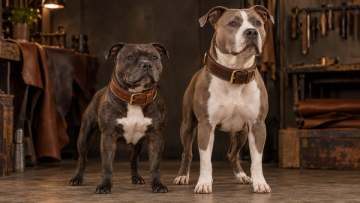
Quick answer: A Staffy and an AmStaff may wear the same collar style, but they should not be assigned the same size, width, or construction just because both are bull breeds. Measure the actual dog and consider neck shape, head size, body weight, leash behavior, escape risk, and everyday use.
Your Staffy sees a squirrel and fires off the sidewalk like a compact rocket. Your AmStaff locks onto something across the street and puts thirty pounds—or plenty more—of determination into the leash. Similar family tree. Very different physics.
Same bull-dog family. Different dog. Buy for the neck, not the label.
The difference you can see in five seconds
A Staffy is usually shorter, lighter, and packed into a compact frame. An AmStaff is generally taller, longer through the body, and heavier. That is a useful starting point, not a sizing system.
A smaller Staffy can hit the end of a leash hard enough to rearrange your coffee. A larger AmStaff with solid training may stroll on a loose leash and barely wake the snap. Breed size affects potential load, but movement and behavior decide when that load shows up.
Read our full breakdown of the differences between a Staffy and an AmStaff for the bigger picture. Here, we are staying at collar level: neck, head, fit, width, and construction.
What physical differences change collar fit?
More body mass can mean more force
An AmStaff usually has more mass to put into a lunge, but a Staffy can deliver a sharper impact from a shorter frame.
The Staffordshire Bull Terrier standard places ideal height at about 14–16 inches. AmStaff breed standards prefer roughly 18–19 inches for males and 17–18 inches for females. Those ranges explain why the breeds should not be treated as two names for the same dog.
Still, the collar does not attach to an average. It attaches to your dog. Watch what happens when a bike passes, a rabbit moves through the yard, or another dog appears at the corner. Does your dog accelerate suddenly, lean steadily, spin, back up, or stay relaxed? That pattern matters.
Neck length sets the practical width limit
Use enough width to create stability and spread pressure, but never enough to jam the jaw or shoulders.
Many Staffies have short, thick necks. A dramatic wide collar can look perfect in a product photo yet crowd the dog when it sniffs the ground. Look for rubbing under the jaw, contact with the shoulder blades, reduced head turning, or a collar that rocks instead of lying flat.
An AmStaff often has more room along the neck, but there is no guarantee. A slim young female and a heavily built adult male are different customers even when the breed name matches.
Our guide to choosing the correct collar width explains the subject in detail. Maximum width is not a personality test.
Head size changes backup and escape needs
If the head is close in width to the neck, test whether the dog can back out of a fixed collar.
With the dog calm, apply only gentle backward pressure. Watch whether the collar travels over the base of the ears. A scared dog may drop its head, flatten its ears, and reverse hard. That is when a loose buckle collar can become an exit ramp.
This can happen with either breed. One Staffy may be completely secure in a classic collar; another may need a correctly fitted half-check or a harness backup. The same rule applies to AmStaffs.
How to measure without guessing
Measure the dog where the collar will sit and follow the instructions for the exact collar design.
- Have the dog stand in a natural position.
- Place a flexible tape around the middle of the neck.
- Keep it comfortably close without squeezing the throat.
- Check how much vertical room exists between the jaw and shoulders.
- Measure again after movement if the dog has loose skin or a heavily muscled neck.
For a Slade Czech buckle collar, enter the actual neck circumference requested on the page. It is designed to land at the middle adjustment hole. Do not take a loose measurement and then add another inch “for comfort.” That is not comfort. That is a head start.
A closed half-check has to pass over the head and ears, so neck size alone is not enough. Our buckle collar vs half-check comparison explains the different measurements and uses.
Buckle collar or half-check?
Use a buckle collar for a consistent everyday fit
A classic buckle collar works for a dog that stays secure in a fixed opening and does not try to reverse out.
It goes on without passing over the ears, stays the same circumference under tension, and provides adjustment holes for minor size changes. That makes it useful for daily wear and growing dogs, provided the fit is checked often.
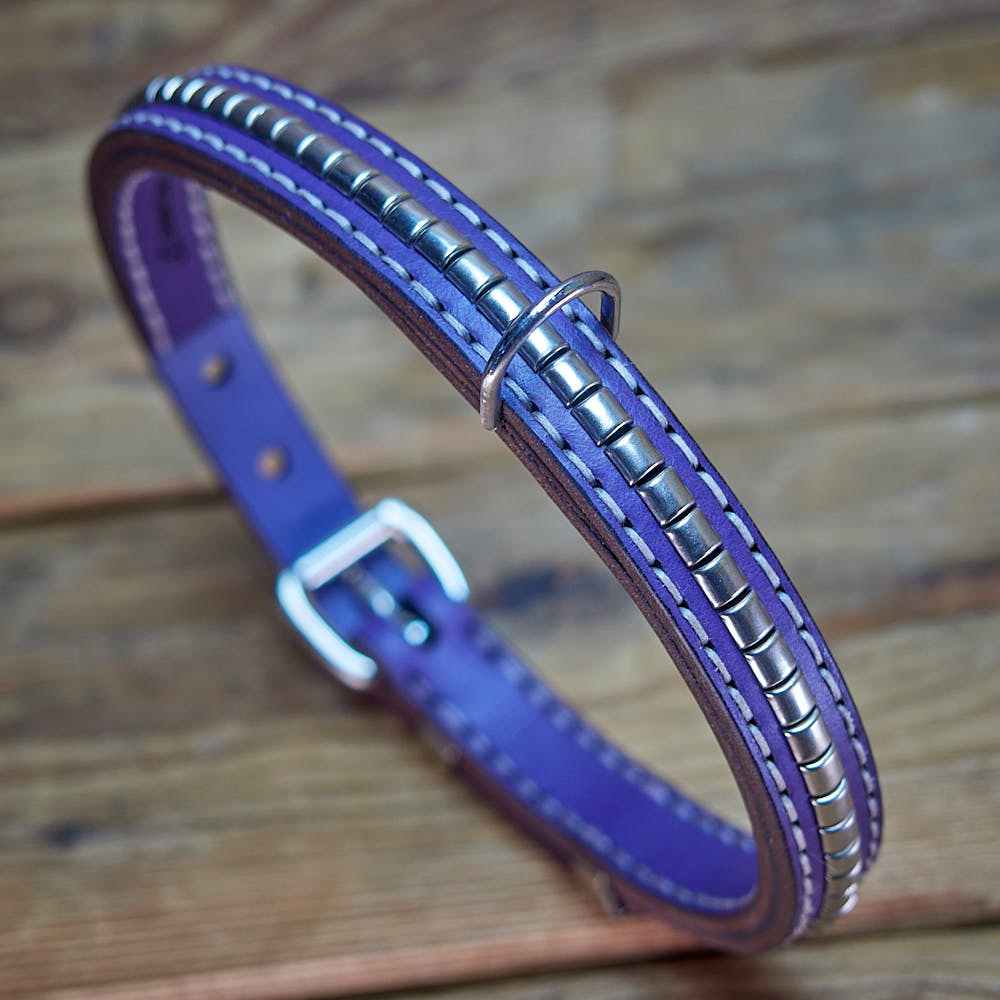
The Django Classic Collar comes in multiple widths, so you can match the same everyday buckle concept to the actual Staffy or AmStaff. It provides stable, fixed fit. It does not teach leash manners or make a wrong measurement disappear.
Use a half-check when limited movement improves security
A properly measured half-check can tighten through a controlled range when the leash comes under tension.
On a loose leash, it rests more freely. When the dog pulls or backs up, the control section shortens the loop. It is not supposed to close without a limit, and it is not a tool for snapping corrections into the neck.
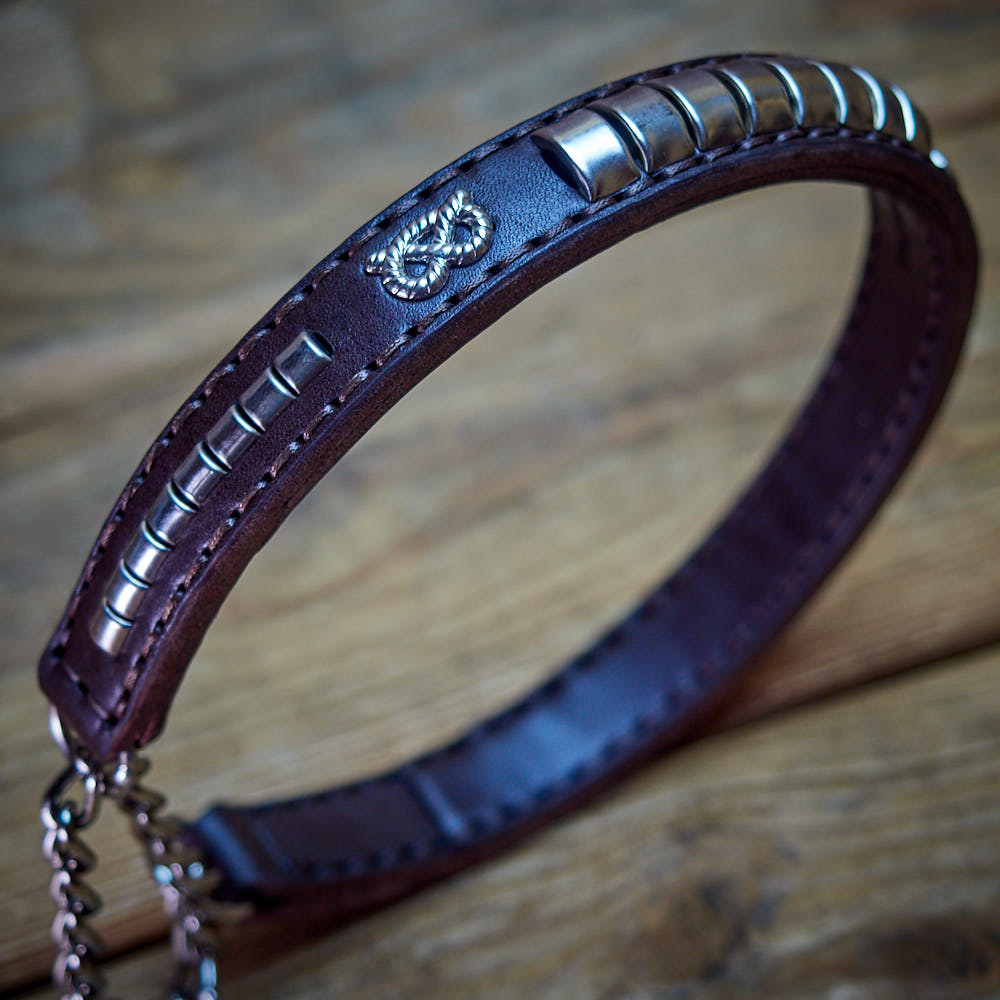
The Craze Half-Check Collar can help when the dog’s proportions or escape behavior make a fixed opening less secure. It improves connection and handling. It will not fix anxiety or turn a freight-train puller into a polite sidewalk philosopher.
How wide should a Staffy or AmStaff collar be?
Choose width for neck length, neck circumference, strength, and job—not merely for breed.
- A growing puppy should not carry unnecessary bulk and needs frequent fit checks.
- A compact adult Staffy may benefit from a stable wider collar, but a short neck limits the usable width.
- A larger AmStaff may carry more width comfortably if the jaw and shoulders remain clear.
- A calm dog does not need maximum hardware to prove it belongs to the bull-breed club.
- A hard puller needs suitable equipment plus training, not a decorative suit of armor.
Watch the collar while the dog sniffs, turns, shakes, and looks up. It should stay reasonably flat. A collar that folds into a narrow ridge is not spreading load as intended. A collar that pushes the jaw upward is too wide.
When a wide double-layer collar earns its place
A wide, double-layer collar makes sense for a sufficiently long, broad neck when you want stable load distribution and a substantial fixed fit.
The King’s Colours Classic Collar has a 40 mm double-layer construction. It can suit a solid adult Staffy or AmStaff when that width fits between the jaw and shoulders.
It will not tighten if the dog backs out. It will not teach loose-leash walking. It will, however, remain a real piece of working equipment when your dog sees a squirrel and suddenly files a flight plan.
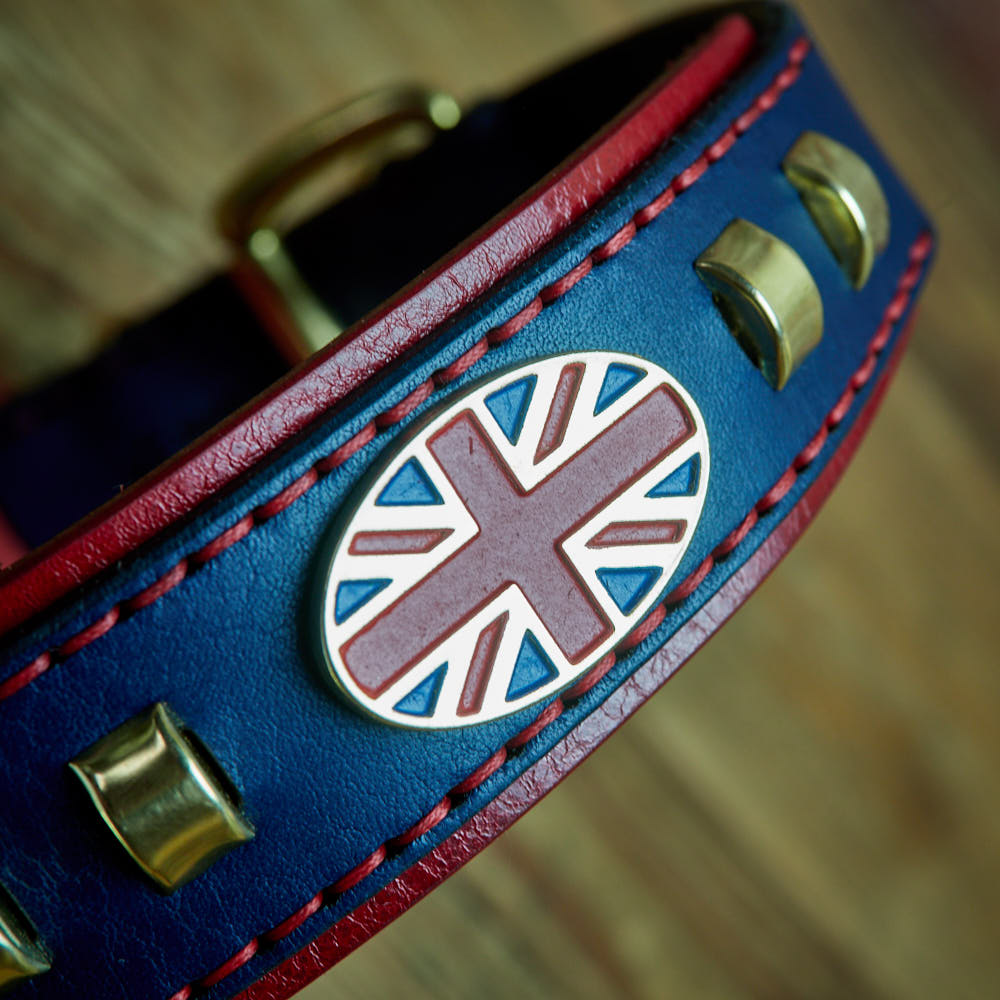
Leather and hardware: inspect the full load path
A collar is only as dependable as the leather, stitching, buckle, D-ring, and material supporting each fitting.
A thick collar can still fail around stretched holes, exposed thread, or a poorly supported D-ring. Check that the buckle tongue sits squarely, the stitches remain even, and the leather does not tear or stretch around high-load points.
After wet walks, let leather dry naturally away from direct heat. Inspect the collar regularly for loose hardware, cracked leather, damaged thread, or distorted holes. Strong gear is not immortal gear.
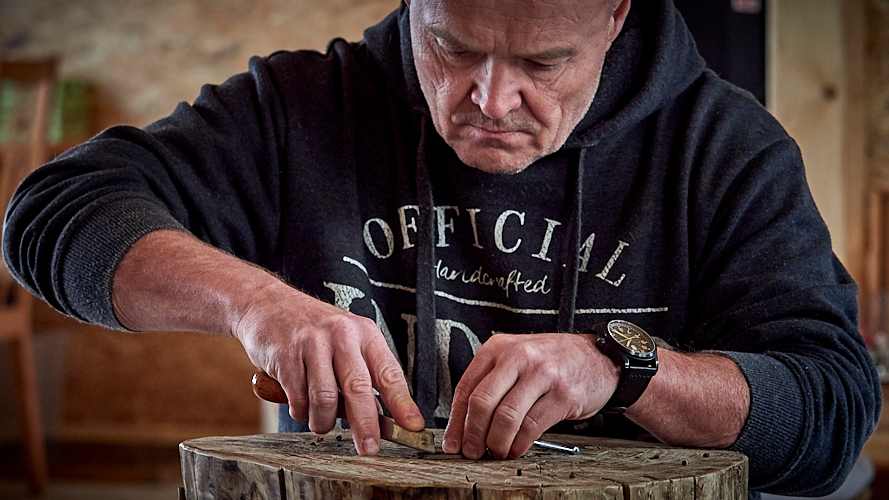
Looking tough on a screen and holding firm when the leash goes tight are not the same job. Slade Czech has built leather gear by hand since 2004, with real pulling, sudden stops, and bull-breed enthusiasm in mind.
Fast decision: if A, choose X
- Calm dog, secure in a fixed opening: properly fitted buckle collar.
- Growing puppy: adjustable buckle collar with weekly checks.
- Dog backs out: measured half-check or secure harness backup.
- Very short neck: moderate width even on a powerful dog.
- Broad neck with enough length: stable wider construction may fit well.
- Dog pulls constantly: manage triggers and train loose-leash walking.
- Coughing, pain, or breathing concerns: stop neck pressure and contact a veterinarian.
Mistakes that create trouble
Ordering “Staffy size” or “AmStaff size”
Neither breed has one universal neck size. Measure the individual dog, especially during adolescence.
Assuming wider is always safer
Too much width can restrict the jaw, neck, and shoulders. Use the widest functional option, not the widest option on the menu.
Adding comfort twice
Do not measure loosely and then add more room. An oversized collar can rotate, catch during play, or slip over the head.
Expecting the collar to stop pulling
Equipment manages contact; training changes behavior. Reward slack before the dog reaches full arousal and practice where success is possible.
When you need professional help
Call a qualified reward-based trainer or behavior professional if your dog lunges aggressively, panics, redirects onto the leash or handler, or repeatedly escapes. Sudden collar sensitivity, coughing, gagging, voice changes, pain, or reduced head movement should be evaluated by a veterinarian.
For a serious flight risk, use a well-fitted harness and secure backup connector while working on the underlying fear. Today’s backup prevents the escape. Tomorrow’s training changes the reason.
Frequently asked questions
Does every AmStaff need a wider collar than a Staffy?
No. AmStaffs are generally larger, but width must fit the individual neck, strength, and use.
Is a 40 mm collar right for every adult Staffy?
No. Some short Staffy necks do not have enough room between the jaw and shoulders.
Will a half-check stop my dog from pulling?
No. It may improve handling and security, but training must change pulling behavior.
Can a Staffy or AmStaff slip out of a buckle collar?
Yes. Risk depends on head-to-neck proportions, collar fit, and backward escape behavior.
How often should I check a puppy collar?
Check it weekly and after visible growth. Bull-breed puppies can outgrow a setting quickly.
Can my dog wear a half-check all day?
No. Remove it for crating, rough play, and any unsupervised time because moving parts can catch.
Is leather strong enough for a powerful AmStaff?
Quality leather with suitable stitching and hardware can handle powerful dogs, but it must be sized and inspected correctly.
Fit the dog you actually own
A Staffy does not automatically need the small option. An AmStaff does not automatically need the heaviest option. Measure, observe, and decide what the collar must accomplish.
Pick the function first. Then choose the colors and hardware that make strangers turn around for a second look. Explore our handmade leather buckle collars.